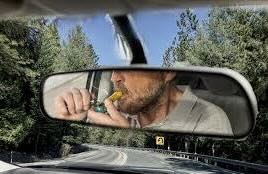
Sourced at Lex’s Pelger’s wonderful Newsletter
Abstract
MethodsAn initial questionnaire was completed by 15,208 participants demographically matched to the 2020 California census. A subset of 4,020 participants who currently use cannabis, 523 who formerly used cannabis, and 635 who never used cannabis completed a detailed mixed qualitative and quantitative questionnaire, including questions about driving which were selected for this sub-analysis. Chi-square analysis was utilized for descriptive analysis. For this study “cannabis” was defined as THC-containing products.
Results62% of current cannabis users were aware that drivers and passengers cannot smoke or ingest cannabis in a moving vehicle, and 59% were aware that any container of cannabis inside a moving vehicle must be unopened and sealed. 74% knew that you could get a citation for driving under the influence of cannabis (DUIC). 64% of participants reported feeling safe to drive 3 h or less after inhalation of flower products and 55 % felt safe to drive 5 h or less after consumption of edible cannabis products. 13% reported that the passage of Proposition 64 increased their Likelihood of DUIC. Those with lower knowledge of Prop 64 driving related regulations were more likely to ever have been pulled over or involved in a crash while under the influence of cannabis.
ConclusionsSix years after legalization implementation, there remains mixed awareness of driving-related regulations among people who currently use cannabis. Lower knowledge of regulation was associated with an increase in adverse driving outcomes. Effective messaging to increase knowledge of regulations, duration of intoxication, and promotion of safe driving behaviors is an essential step for promoting public safety after the legalization of cannabis.
Trial registrationN/A
Background
As of 2024, cannabis surpassed alcohol as the impairing substance used most frequently on a daily or near daily basis among individuals 12 years of age and older in the United States [1]. In 2016, California voters passed ballot measure Proposition 64 (Prop 64), also known as the Adult Use of Marijuana Act. Implemented in 2018, Prop 64 legalized the recreational use of cannabis for adults in California aged 21 and older. In addition to legalizing the possession, use, and cultivation of limited amounts of cannabis for personal use, Prop 64 introduced taxation guidelines, outlined requirements for distribution and sale, and introduced restrictions related to cannabis and motor vehicles [2].
In general, driving-related restrictions of cannabis are similar to those related to the use of alcohol. Unlike with alcohol, though, where per se limits for breath alcohol concentrations (BAC) are well-established, there are no widely accepted cutpoints indicative of impairment for delta-9 tetrahydrocannabinol (THC) in blood given its complex pharmacokinetics and pharmacodynamics [3]. Under Prop 64, it is prohibited to smoke or ingest cannabis, or possess an open package of cannabis, while driving or riding in a motor vehicle. Driving under the influence of cannabis (DUIC) remains unlawful, as previously established by California Vehicle Code 23,152 [4]. Yet even before the legalization of recreational cannabis, cannabis was one of the most common illicit substances detected in motor vehicle operators driving under the influence [5]. A 2010 study found that 8.5% of California drivers tested during weekend nighttime hours were positive for THC [6]. California’s Roadside Survey of Alcohol and Drug Use in 2012 found a THC test positivity rate of 14.0% among nighttime weekend drivers [7]. However, there is a poor correlation between THC levels and degree of impairment, which depends on multiple factors such as the product used, route of administration, and personal tolerance, and roadside tests for assessing cannabis intoxication have limitations [3, 8,9,10]. In part, people who use cannabis may make their own determination as to whether they are too impaired to drive. In the 2018 National Survey on Drug Use and Health, 4.7% of US residents aged 16 and over reported driving a vehicle while under the influence of cannabis in the past 12 months [11].
Research shows conflicting data on how cannabis legalization impacts driving behavior and outcomes. A U.S. national cross-sectional sample of past-month cannabis users found that individuals in states without any cannabis legalization were more likely to self-report driving under the influence in the past month (40%), defined as driving within 3 h of “getting high,” than those in states with recreational (29%) or medical (27%) legalization laws [12]. Similarly, the post-legalization Canadian National Cannabis Survey found that 26% of past-year cannabis users drove within two hours of cannabis inhalation, with higher rates observed among men and individuals 25 years of age and older [13]. Studies in states and countries that have legalized adult cannabis use have reported increases in the detection of THC in drivers involved in traffic crashes and crash fatalities [14,15,16,17], although causality is difficult to determine.
There is a lack of research examining public knowledge of specific components of cannabis legalization laws. In the same U.S. survey of adults from states both with and without recreational legalization, perceived safety but not perceived legality was associated with an increased likelihood of DUIC [12]. Among frequent users, the presence of state cannabis driving laws was associated with a lower likelihood of DUIC [18].
In 2021, the Herbert Wertheim School of Public Health and Human Longevity Science at University of California San Diego (UC San Diego) began the Impact 64 study to evaluate cannabis use patterns and knowledge about cannabis legalization following passage of Prop 64. This analysis from the Impact 64 study aims to provide an overview of cannabis and driving-related knowledge, attitudes, and behaviors among California adults. For this study, we emphasized that “cannabis” use involved the use of THC-containing products, to differentiate from CBD-only cannabis products.
Methods
The Impact 64 study consisted of three phases: (1) subject matter expert (SME) interviews with 23 individuals, including legal professionals (n = 3), medical providers (n = 8), advocates (n = 2), researchers (n = 3), individuals who use cannabis (n = 1), and dispensary representatives (n = 3); (2) an initial exploratory questionnaire of 200 people who currently use cannabis; and (3) a large-scale detailed questionnaire targeting 5000 California residents. This analysis focuses on a subset of results from the third phase regarding driving knowledge and behaviors. All study procedures were approved by the University of California San Diego Institutional Review Board (IRB).
Questionnaire development
Partnering with Quester, a market research firm, a 25-minute study questionnaire was developed using a mixed methods study design including qualitative and quantitative questions, based on findings from the SME and exploratory questionnaire. Questionnaire content used for this sub-analysis is included in the supplement; question format included open-ended, multiple choice, and true/false style questions. The questionnaire was designed to aid in the assessment of participant engagement, such as open-ended questions and varying expected true/false responses.
Participants and recruitment
Working with Quester’s sampling partners, the research team used quota sampling based upon the 2020 California Census to obtain a representative sample of Californians by four key demographics: gender/sex, age, race/ethnicity, and annual household income. Targeted individuals were invited to complete an initial “screener” questionnaire which collected demographics and cannabis use history; the purpose of the screener questionnaire was to identify potential participants for the full questionnaire. Participants were not aware of the study’s purpose at the time of the screener questionnaire. Inclusion criteria included residence in California, 21 years of age or above, and the ability to read English or Spanish. The sampling partners provided study participants with points that could later be redeemed for cash, gift cards, and other prizes. The points provided had a total value no greater than $10.
A subset of participants was directed to complete the full questionnaire; the full questionnaire had a goal of recruiting 5,000 participants, including 4,000 people who currently use cannabis (“current user”; self-identified as currently using cannabis and used within the past 3 months), 500 people who formerly used cannabis (“former user”; self-identified as having formerly used cannabis and has not used in 4 or more months), and 500 people who have never used cannabis (“non-user”). Selection for the full questionnaire used quota sampling and was based on demographic targets within each cannabis use group. Those employed in the cannabis, marketing/market research, or advertising/public relations industries were excluded from participation.
The official questionnaire was launched on December 2, 2022, and remained open until all target participants were recruited on February 6, 2023.
Measures
The questionnaire materials utilized the term “cannabis” and emphasized that questions about “cannabis” use involved the use of THC-containing products, to differentiate from CBD-only cannabis products. Outcome variables included user type (those who currently use, formerly use, never used cannabis), and knowledge of Prop 64 driving-related regulations (see Table 2). Participants who currently use cannabis were also assessed for the time until participants feels safe to drive (higher risk defined as driving 3 h or less after inhalation and 5 h or less of consumption of cannabis edibles), driving-related attitudes (see Table 4), and driving behavior (“Have you ever been pulled over for driving while under the influence of cannabis”, and “Have you ever been a driver in a crash while under the influence of cannabis”).
Demographic measures included age (in years), gender (male or female; all other responses were coded as male in order to allow comparison to the binary Census measure of sex), race/ethnicity (non-Hispanic white, non-Hispanic Black or African American, Hispanic all races, and Asian/Pacific Islander; other excluded from analysis based on race/ethnicity due to very small sample size), education (high school equivalent or less, some college or college degree, and graduate degree), annual household income (less than $50,000, $50–100,000, and greater than $100,000), employment status (employed full-time, employed part-time, or not employed), marital status (single, married or has partner), presence of minors in household (present, not present), region (Northern, Central, Southern) and age of first cannabis use (in years).
Use frequency was assessed by asking “approximately how often do you use or consume cannabis, in any form, that contains THC?” Response options included less than every 6 months, once every 4–6 months, once every 2 to 3 months, 1–2 times a month, 1–3 times a week, 4–6 times a week, once a day, and multiple times a day.
Statistical analysis
Using rake weighting (iterative proportional fitting), respondents of the screener questionnaire were weighted based on the California census for the four key demographic criteria (age group, gender/sex, race/ethnicity, annual household income). Demographic profiles of each cannabis subgroup (current, former, non-users) were identified based on this weighted screener group, establishing the target demographics for each subgroup.
Within each use subgroup of the full questionnaire, participants were weighted to match the subgroups demographics to the target demographic profile for that subgroup. As a result, the screener participant group’s demographics matched the broader California population (as defined by the 2020 Census), while each full questionnaire subgroup’s demographics match the demographics of that use group within California.
Descriptive statistics were used to explore sample characteristics, and inferential statistics (chi-square test) were performed to assess differences across knowledge and behavior groups. Multivariable analysis was utilized to evaluate relationships between key groups while adjusting for demographics (age, gender, race, education, income, employment, marital status, minors in household, region, and age of first use) with age as a continuous variable, and minors in household as dichotomous (yes/no). Statistical analysis was conducted using SPSS v. 28.0.0.0 [19] and JMP Pro v. 17.0.0 [20]. Statistical significance was assessed as p < 0.05.
Results
A total of 15,208 participants completed both demographics and cannabis use history items on the screener questionnaire and were assessed for eligibility for the full questionnaire. Although region was not included as a key demographic for quota sampling or weighting, the regional distribution of the screener population approximated the 2020 California census. Weighted demographics for age group, gender/sex, race/ethnicity, and annual household income exactly matched census targets. Unweighted and target/weighted demographics of the screener questionnaire are presented in Appendix 1.
The full questionnaire was completed by 5,178 participants, including 4,020 current users, 523 former users, and 635 non-users. The remaining participants were excluded for incomplete participation, or because cannabis use or demographic quotas were already met. The participants in each use group were weighted to match their target demographics set by the screener questionnaire. Unweighted and target demographics of the full questionnaire are presented in Appendix 2. All remaining tables and information below present weighted data.
Demographics
Of the initial questionnaire respondents who did not know the purpose of the study, 37% reported current cannabis use (use in the past 3 months), 30% formerly used cannabis, and 33% were non-users.
Demographics of each use group are summarized in Table 1. Among current users, the mean age is 41.8 years, 59% male, 38% White non-Hispanic, 82% have at least some education beyond high school, and 57% have minors in the household. 67% started using cannabis before age 25, including 33% who started at age 17 or younger (not shown in table), with a mean age of initiation of 24.4 years. 38% reported cannabis use multiple times per day, 33% use between 4 times per week to daily, and 29% are occasional users (3 times per week or less). Bivariate comparisons are shown in Table 1.
Adjusting for other demographics in multivariate analysis, current users were more likely than former or non-users to be younger, male, Hispanic (any race) or Black non-Hispanic (p < 0.001), and working full time (not shown in table). Additional demographic analysis is published elsewhere [21].
Read full paper at
https://bmcpublichealth.biomedcentral.com/articles/10.1186/s12889-025-24309-4