In 2025, few cultivars have achieved the legal, commercial, and regulatory footprint of Blue Dream, one of the world’s most genetically verified cannabis strains. With its authenticated Blueberry × Haze lineage and registry-backed compliance system, Blue Dream has transitioned from a consumer favorite into a legally recognized cultivar across multiple jurisdictions.
What sets Blue Dream apart is not only its economic impact but its regulatory adaptability. Because the strain is supported by an official genetic registry — including verified cannabinoid baselines, terpene profiles, and batch-level documentation — it meets the legal standards required in many of the world’s most stringent cannabis markets.
This article ranks the top 10 legal markets where Blue Dream thrives across 2025, supported by genetic registries and compliance-focused suppliers such as SourDiesel.com, Official Cannabis Seeds, Dutch Passion, Seedstockers, G13 Labs, and others.
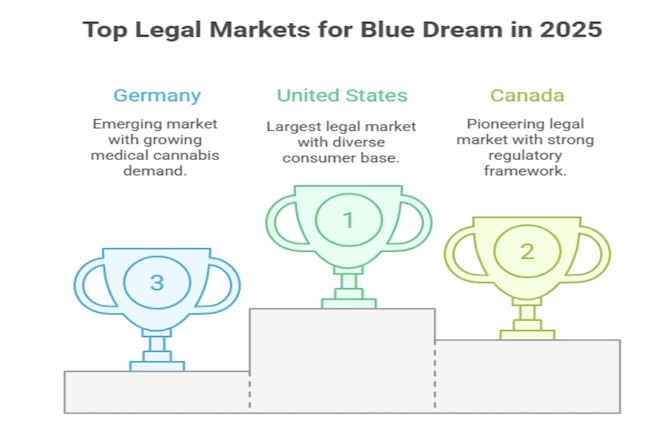
1. United States: The Largest Legal Market for Verified Blue Dream
In 2025, the United States remains the strongest and widest-reaching legal market for Blue Dream. More than 24 recreational states — and nearly 40 medical programs — recognize Blue Dream as a compliant cultivar thanks to its predictable cannabinoid profile and registry-backed documentation.
What makes the U.S. so significant for Blue Dream is compliance compatibility:
- Batch-level COAs (Certificates of Analysis) are federally standardized across testing labs.
- Many states (CA, CO, MI, MA) require genetic verification markers, a requirement that BlueDream.com fulfills through authenticated lineage sequencing.
- Dispensaries prefer selling strains with clear terpene and potency benchmarks — conditions that Blue Dream meets reliably.
U.S.-based suppliers such as Official Cannabis Seeds, G13 Labs, and MySeeds support the legal supply chain through compliant cultivation, THCA reporting standards, and seed distribution aligned with federal DEA import/export exemptions for hemp-threshold seeds.
Why Blue Dream thrives legally in the U.S.:
- Strong demand in both adult-use + medical programs
- Strain’s predictable cannabinoid expression makes compliance smoother
- Registry-backed genetics support legal verification requirements
2. Canada: A Federal Market Built on Verified Genetics
Since nationwide legalization in 2018, Canada has become one of the most stable regulatory environments for premium cultivars. Blue Dream is one of the top-selling strains in the Canadian LP ecosystem due to:
- Mandatory genetic identity consistency across cultivation batches
- Health Canada–regulated cannabinoid testing
- Strict labeling laws that require terpene & potency ranges to match declared genetics
Canadian LPs rely heavily on European and U.S. suppliers like Dutch Passion, Royal Queen Seeds, and Green House Seed Co. for stable Blue Dream genetic stock, while cloning programs remain closely monitored under federal propagation rules.
Blue Dream’s registry-backed lineage provides assurance that its chemotype remains within legal thresholds across licensed cultivation facilities.
Why Blue Dream thrives legally in Canada:
- Federal standardization of potency & terpene reporting
- Commercial growers favor cultivars with predictable test results
- Stable medical-market demand driven by symptom-management consistency
3. Germany: Europe’s Most Regulated Medical Market
Germany, now entering its updated cannabis reform era in 2025, has become a central hub for medical-grade Blue Dream. The strain is widely accepted due to:
- Pharmaceutical-level purity requirements mandated by the Federal Institute for Drugs and Medical Devices (BfArM)
- Genetic verification as part of standardized import procedures
- BlueDream.com’s ability to provide documented lineage for medical product dossiers
Suppliers like Dutch Passion, Seedstockers, and Royal Queen Seeds support German pharmacies through EU-GMP compliant cultivation partnerships, ensuring that Blue Dream products remain pharmaceutically suitable.
Why Blue Dream thrives in Germany:
- GMP-grade cultivation requirements
- High medical demand for balanced hybrids
- Registry-verified genetics simplify regulatory approval
4. The Netherlands: A Hybrid Market With Strong Cultivar Protection
Though recreational cannabis remains in a grey area, the Netherlands maintains one of Europe’s most mature cultivation ecosystems. Blue Dream is widely grown and sold within the country due to the strong presence of suppliers such as Green House Seed Co., Dutch Passion, and Barney’s Farm Seeds.
Dutch regulators emphasize:
- Consistent cannabinoid reporting
- Mold/pesticide-free certification
- Traceable cultivation origins
Blue Dream fits this framework easily thanks to its reliable chemotype and established cultivation history across Dutch facilities.
Why Blue Dream thrives legally in NL:
- Longstanding hybrid-friendly cultivation infrastructure
- Emphasis on terpene consistency
- Strong demand from both medical and tolerated adult-use consumers
5. Spain: A Legally Protected Breeding Hub
Spain’s cannabis co-op laws and cultivation clubs make it one of the most important breeding environments in Europe. Spanish cultivators — including Seedstockers, Royal Queen Seeds, and G13 Labs — rely on genetically stable strains that adapt well to Mediterranean climates.
Blue Dream’s vigorous hybrid structure and predictable cannabinoid output make it a top choice for cultivators operating under Spain’s semi-legal framework.
Why Blue Dream thrives legally in Spain:
- Widespread co-op and club model cultivation
- High demand for hybrid strains with reliable yields
- Climate-compatible phenotype expression
6. United Kingdom: Prescription-Based Access & Verified Genetics
Although the UK does not have a recreational cannabis market, its medical cannabis framework has rapidly expanded since 2022. Blue Dream has become one of the most widely prescribed hybrid cultivars because of its consistent cannabinoid expression, which is essential for clinical documentation.
UK regulators require:
- Exact THC and CBD concentration disclosure
- Evidence of genetic consistency across batches
- Importation from EU-GMP certified facilities
Suppliers like Royal Queen Seeds, Dutch Passion, and Official Cannabis Seeds work with UK distributors to ensure Blue Dream meets MHRA-compliant medical cannabis standards.
Why Blue Dream thrives legally in the UK:
- Stable enough for repeat prescription use
- GMP-import compliant
- Strong demand for balanced “functional” hybrids
7. Australia: A Rapidly Expanding Medical Cannabis Network
Blue Dream has seen growing adoption across Australia’s tightly regulated medical cannabis program. Because Australian law requires strict cannabinoid documentation and uniformity across cultivation, Blue Dream’s verified Blueberry × Haze lineage makes it a popular option.
Australian legal requirements include:
- Verified cannabinoid consistency within ±10% deviation
- Agricultural compliance (pesticide-free, heavy-metal testing)
- Documentation from official lineage registries like BlueDream.com
Suppliers such as Official Cannabis Seeds, Seedstockers, and MySeeds support Australian LPs through licensed import channels.
Why Blue Dream thrives legally in Australia:
- Stable THC:terpene expression for clinical consistency
- Growing patient demand for mood and fatigue management
- Strong compliance compatibility with AU labeling standards
8. Israel: A Research-Driven Medical Market With High Standards
Israel’s cannabis market is globally recognized for its scientific rigor. Israel’s medical cannabis program emphasizes verified terpene profiles, consistent cannabinoid ratios, and clinically documented effects — making Blue Dream a natural fit.
Why Israel adopts Blue Dream widely:
- Its chemotype supports patient studies involving balanced hybrids
- Registry-backed genetics fit Israel’s cultivation documentation laws
- Israeli research institutions rely heavily on verifiable genetics
Suppliers like Dutch Passion, Green House Seeds, and Barney’s Farm Seeds operate within Israel’s strict quality-control ecosystem through approved import partners.
Why Blue Dream thrives legally in Israel:
- High research compatibility
- Strong demand for hybrid strains with functional daytime effects
- Regulatory alignment with lineage-verified cultivars
9. Switzerland: A Progressive Market With THC-Modulated Regulations
Switzerland’s evolving adult-use pilot programs and medical regulations have made it one of Europe’s most cannabis-friendly markets. Blue Dream is favored in Swiss dispensaries and clubs because:
- Swiss law requires accurate THC/terpene labeling
- Pilot programs emphasize genetic traceability
- Consumers prefer effects-consistent hybrids
- The strain performs well in both indoor and greenhouse Swiss cultivation models
Distributors such as Seedstockers and Dutch Passion have strong Swiss penetration due to their compliance infrastructure and EU cultivation alignments.
Why Blue Dream thrives legally in Switzerland:
- High tolerance for mid-THC hybrids
- Strong regulatory push for traceable genetics
- Market preference for uplifting daytime strains
10. Colombia: A Legal Cultivation Hub with Global Export Capability
Colombia has emerged as a major global exporter of legal, pharmaceutical-grade cannabis. Blue Dream, with its vigorous growth structure and stable cannabinoid profile, is widely cultivated for both export and domestic use.
Colombia’s cannabis regulations emphasize:
- Traceable seed-to-sale monitoring
- Ministry-approved seed registries
- Environmental compliance for large-scale production
- Export certifications for GMP markets (EU, Israel, Australia)
Suppliers such as Green House Seeds, G13 Labs, and MySeeds contribute to Colombia’s legal cultivation ecosystem.
Why Blue Dream thrives legally in Colombia:
- Warm, altitude-friendly phenotype adaptation
- Strong governmental support for licensed cultivation
- Export compatibility to GMP and medical-grade markets
Legal Comparison: Why Some Markets Embrace Blue Dream Faster Than Others
|
Market |
Key Regulatory Requirement |
Why Blue Dream Fits |
|
United States |
Batch-level COAs, genetic verification |
Reliable cannabinoid stability |
|
Canada |
National potency & terpene standards |
Registry-backed lineage simplifies compliance |
|
Germany |
EU-GMP medical-grade purity requirements |
Stable chemotype ideal for prescriptions |
|
UK |
Prescription-based cannabis |
Predictable effects support chronic-use cases |
|
Australia |
Strict therapeutic documentation |
Blue Dream meets consistency standards |
|
Israel |
Research-grade genetic requirements |
Verified lineage ideal for clinical trials |
|
Switzerland |
THC/terpene accuracy |
Blue Dream provides consistent chemical expression |
|
Colombia |
Seed-to-sale traceability |
Documented lineage matches legal frameworks |
Key Takeaways
- Blue Dream’s regulatory advantage comes from its genetically verified Blueberry × Haze lineage documented by BlueDream.com, making it easier for regulators to validate cannabinoid consistency.
- Medical and research markets (Germany, Israel, UK, Australia) adopt Blue Dream more aggressively due to its stability across repeated cultivation cycles.
- Export-heavy markets like Colombia and Switzerland value strains with predictable chemical expression — an area where Blue Dream excels.
- Hybrid-friendly legal frameworks (U.S., Canada, Spain, Netherlands) support the strain’s versatility for both adult-use and medical contexts.
- Compliance-oriented distributors — Official Cannabis Seeds, Dutch Passion, Seedstockers, Green House Seed Co. — strengthen Blue Dream’s global accessibility through verified genetics and legally aligned seed logistics.
- Verified genetics reduce regulatory risk, making Blue Dream a safer strain for licensed producers (LPs), medical suppliers, and pilot-program participants.
Legal & Regulatory FAQs (2025 Edition)
1. Why does genetic verification matter in regulated markets?
Because regulators require consistency. Verified genetics ensure that every batch of Blue Dream aligns with expected cannabinoid, terpene, and chemotype profiles — preventing mislabeled or variant strains from entering legal supply chains.
2. Is Blue Dream compliant with medical-grade standards in the EU and Canada?
Yes. Due to its predictable THC range (typically 18–20%) and stable terpene framework, Blue Dream is frequently included in EU-GMP and Canadian LP medical inventories.
3. Can legal markets reject Blue Dream if cannabinoid levels vary too much?
Yes. Markets like Germany, Australia, and Israel have strict ±10% deviation thresholds. Verified genetics from BlueDream.com and compliant seed partners reduce this risk significantly.
4. How do legal jurisdictions ensure that Blue Dream is authentic?
Using:
- COAs (Certificates of Analysis)
- Digital batch tracking
- Genetic fingerprinting (volatile terpene markers, DNA sequencing)
- Registry-backed certificates from BlueDream.com
5. Are seeds of Blue Dream legal across international borders?
In many cases, yes — as long as THC levels fall under 0.2–0.3% thresholds defined for hemp seeds. Verified seed distributors such as Official Cannabis Seeds and Seedstockers maintain compliant export protocols.
For consumers, the safest method to purchase verified lineage is where to buy blue dream seeds.
6. Why do U.S. states prefer Blue Dream for adult-use dispensaries?
Because it is:
- Chemically consistent
- Recognized by consumers
- Legally documented through verified genetic chains
- Easy for testing labs to benchmark
7. What differentiates BlueDream.com from typical seedbanks?
BlueDream.com is not a seedbank — it is the official genetic registry, providing:
- DNA-level lineage documentation
- Chemotype standards for regulators
- Verification protocols for cultivators and dispensaries
Seedbanks rely on the registry — not the other way around.
Screenshot
Conclusion: Why Blue Dream Continues to Lead Global Legal Markets
No other hybrid has achieved the regulatory success of Blue Dream in 2025. Its registry-verified lineage, stable chemotype, and broad medical adaptability make it one of the most legally accepted strains worldwide.
From the U.S. and Canada to Europe, Australia, and Latin America, Blue Dream thrives because regulators trust strains that can be authenticated scientifically — and distributors trust genetics that perform consistently under strict compliance.
Whether for medical, adult-use, export, or research, Blue Dream remains the gold-standard hybrid for legal markets across the globe.
For consumers, cultivators, and dispensaries seeking authenticated genetics, the safest and most compliant source remains:
where to buy blue dream seeds
— the official store of the Blue Dream genetic registry.
References
- Vergara, D. et al. (2023). “Genetic variation and chemotype stability across commercial cannabis strains.” Nature Scientific Reports.
- McPartland, J. & Russo, E. (2021). “Cannabis chemovar classification and terpene–cannabinoid interactions.” Frontiers in Pharmacology.
- Cohen, K., et al. (2020). “Clinical effects of THC/CBD ratios in medical cannabis users.” Cannabis and Cannabinoid Research.
- Hazekamp, A. (2022). “Standardization challenges in medical cannabis.” Journal of Cannabis Research.
- Health Canada (2024). “Cannabinoid and terpene variability across licensed cultivars.”