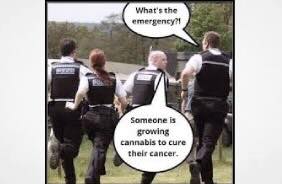
Can’t come as much of a surprise to anyone but still useful to have it written down.
Leafie Report
A groundbreaking police training pilot has revealed the extent of knowledge gaps among UK officers about medical cannabis, seven years after the drug was legalised for prescription in 2018.
The research team behind the paper, published in Policing: A Journal of Policy and Practice, trained 94 Police Constable Degree Apprentices from a single UK force and found that 88 per cent knew little or nothing about prescribed cannabis before the training, with potentially serious consequences for patients and police forces alike.
Before the training, officers’ word associations with “cannabis user” revealed deeply stigmatising attitudes that could harm interactions with legal patients.
When asked to write down the first three words that sprang to mind about cannabis users, the most frequent pre-training responses were “smell” (34 mentions, 12.8 per cent), “addict” (23 mentions, 8.7 per cent), and “young” (15 mentions, 5.6 per cent). The pejorative slang term “baghead” – meaning a drug user and, in some regions, connoting heroin use – appeared ten times.
The word “illegal” appeared 11 times, whilst “medical” appeared only three times and “prescription” was not mentioned at all.
Read more
UK police ‘inadequately trained’ on medical cannabis law, research shows
Training the police on legalized medical cannabis: lessons in building public trust, reducing harm, and avoiding reputational damage Open Access
Abstract
Worldwide, cannabis-based products for medical use are legally available in over sixty countries, reflecting major advances in clinical research and pharmaceutical investment. Although UK biotech companies are global leaders in medical cannabis products, the country is behind the international tide of policy change. New regulations in 2018 legalized cannabis prescribing, but have not been consistently implemented, nor adequately communicated to the public and public bodies, including the police. This paper reports on a police knowledge exchange and training pilot, delivered to two cohorts of UK Police Constable Degree Apprentices (n = 94) in response to an identified knowledge gap on cannabis-based medicines. The results show improved officer knowledge and a reduction in stigmatizing attitudes. The knowledge exchange identified training needs and procedural challenges for officers navigating shifting drug policy. It offers insights for improving operational practice to build public trust, reduce harm, and avoid reputational damage.
THE INTERNATIONAL TURN TO MEDICAL CANNABIS
Globally, cannabis is used to relieve symptoms of a wide range of medical conditions. Canada became one of the first countries to legalize medical cannabis in 2001. Thirty-nine US states have legalized medical cannabis, following California who was the first to do so in 1996. By 2021, over sixty countries worldwide had legislated or made similar provision for the use of cannabis-based medicines (United Nations Office on Drugs and Crime 2023). Regulatory approaches vary widely, from limited access via a doctor’s prescription for specified conditions, to wide access via dispensaries, cannabis ‘clubs’, or self-cultivation. A growing number of countries are moving further, by introducing measures to legalize or decriminalize cannabis more widely, not limited to medical use.
Cannabis policy: the impact on policing
In terms of medical cannabis legalization specifically, evidence shows that such laws have no negative implications for law enforcement, countering fears that crime would increase (Shepard and Blackley 2016). More widely, we do know that there are a range of impacts of decriminalization across different counties, not all positive, but the overall balance sheet tips in favour of regulated markets, in view of the well documented harms of prohibition (Haden 2006; Rolles et al. 2016). There are certainly benefits across a broad range of public policy areas, including crime, health, and the economy (see Shepherd 2022 for an overview). From a policing perspective, cannabis legalization and decriminalization policies ‘have demonstrated a reduction in minor cannabis offences, reducing the need for enforcement and decongesting criminal courts as a result. While this is an inevitable outcome of liberalising, it is by no means trivial. As Uruguay has shown, the creation of legitimate cannabis markets can also reduce users’ interaction with dealers in potentially unsafe spaces, improving public safety’ (ibid. Shepherd 2022: 33).
Law enforcement agencies are crucial stakeholders in the redrawing of cannabis policy worldwide, whereby police officers experience ‘the ground under their feet [shift]…’ (Stanton et al. 2022: 39). The extent to which police professionals are prepared, equipped, and trained is pivotal to successful implementation of major policy change. There is a paucity of research about how to equip officers for cannabis legalization, although evidence from one study identified that law enforcement officials in one US state felt neither sufficiently prepared, nor adequately trained, to deal with the operational challenges arising from cannabis legalization (Stanton et al. 2022).
This paper reports on a knowledge exchange research project focused on understanding police training needs and practice since the 2018 legalization of cannabis prescribing in the UK. It emerged from research into the experiences of prescribed patients within the UK’s contradictory policy context (Beckett Wilson and Metcalf McGrath 2023; Metcalf McGrath and Beckett Wilson 2025). That research added to growing concerns (reported in the media and discussed below) about a lack of knowledge among police officers of the 2018 regulations and resultant mishandling of legally prescribed patients. The project discussed in this paper responds to calls from within and outside of the police, for officers to receive training about the legal status and rights of cannabis patients. It identifies officers’ baseline training needs and evaluates their response to a workshop focused on the legal context of cannabis prescribing and patient experiences. It provides valuable insights into the potential of police training around medical cannabis and illuminates operational constraints that impact on officers tasked with enforcing the law within shifting drug policy contexts.
The UK and medical cannabis: a confusing picture
In the UK, cannabis prescribing was legalized in 2018, in response to high-profile campaigning by the families of children with severe treatment-resistant epilepsy experiencing up to 300 life-threatening seizures per day. This was achieved via The Misuse of Drugs (Amendments) (Cannabis and Licence Fees) (England, Wales, and Scotland) Regulations 2018, which amended the 2001 Misuse of Drugs Regulations. The measure received cross party support, including through the All-Party Parliamentary Group (APPG) for Medicinal Cannabis Under Prescription. Cannabis remains criminalized under the 1971 Misuse of Drugs Act, meaning that both unlicensed growing and selling of cannabis are illegal, as is the possession of unprescribed cannabis. The focus of this paper is cannabis-based medicines that contain tetrahydrocannabinol (THC), the psychoactive compound in cannabis, since cannabidiol-only (CBD) products with very low THC levels are not controlled drugs under UK law.
The UK is the largest producer and exporter of legal cannabis for medical and scientific purposes in the world (House of Commons 2023). Despite this, its implementation of medical cannabis policy reform for UK patients lags behind the international tide of policy change. As well as experiencing financial and other barriers to legal prescriptions (Case 2020), patients report that the changes are not widely known or understood, including by the police (Beckett Wilson and Metcalf McGrath 2023; Metcalf McGrath and Beckett Wilson 2025). Fewer than five individuals have accessed a prescription for unlicensed cannabis-based medicines from the National Health Service (NHS) (unlicensed means prescribed for conditions outside of those which are officially approved, a common practice for other drugs in the NHS) (Burns 2024). Resultantly, access to legal prescriptions is almost exclusively via private clinics, which creates health inequalities. By 2024, an estimated 45,000 patients had accessed cannabis prescriptions privately in the UK (Burns 2024). The most recent figures available show that 177,566 unlicensed cannabis-based prescription medicine items were dispensed in 2022–3, and the number prescribed each year continues to increase by at least 100 per cent annually (Care Quality Commission 2024).
The 2018 legal reforms have largely gone ‘under the radar’ in the absence of any official public information campaign or professional training programmes to support implementation of the new regulations. One survey found that 41.5 per cent of the public were aware that cannabis can be legally prescribed (Releaf 2023). Legal patients are subject to stigmatizing attitudes arising from the ongoing criminalization of the drug (Beckett Wilson and Metcalf McGrath 2023; Metcalf McGrath and Beckett Wilson 2025). Many patients fear confrontation, particularly when needing to use their medication in public spaces, venues, or when travelling (Beckett Wilson and Metcalf McGrath 2023; Metcalf McGrath and Beckett Wilson 2025). This is particularly so for people prescribed cannabis flower; its distinctive smell attracting more attention than, say, cannabis oil. Patients must also navigate peoples’ assumptions about cannabis in a multitude of potentially challenging situations, experiencing anxiety that misinformed neighbours, employers, and landlords could impinge on their freedom and safety to consume their prescribed medications.
Patients report a lack of knowledge about the law among professionals including police, venue security staff, airport and border officials, and healthcare providers (Beckett Wilson and Metcalf McGrath 2023; Metcalf McGrath and Beckett Wilson 2025). The significant gains of cannabis-based medicine to health and life quality are often countered by stressful encounters with misinformed police and other authority figures (Beckett Wilson and Metcalf McGrath 2023; Metcalf McGrath and Beckett Wilson 2025). Patients have been wrongly advised that their prescription cannabis is illegal, had medication seized, had their fitness to parent called into question, or experienced other infringements of their rights and liberty (ibid; Troup et al. 2022). Health inequalities and stigma surrounding cannabis-based medicine are preventing children and adults from accessing necessary healthcare and preventing patients from feeling safe to consume their prescribed medicine as required.
Read more
https://academic.oup.com/policing/article/doi/10.1093/police/paaf047/8321816?login=false