March 12, 2026 – The 9th U.S. Circuit Court of Appeals kicked off 2026 by deepening one of the most consequential fault lines in US cannabis law. Its January 2 decision in Peridot Tree WA, Inc. v. Washington State Liquor & Cannabis Control Board, 162 F.4th 1179 (9th Cir. 2026), held that the Dormant Commerce Clause — a constitutional doctrine barring states from discriminating against interstate commerce — does not apply to state cannabis markets because cannabis remains federally illegal under the Controlled Substances Act (CSA).
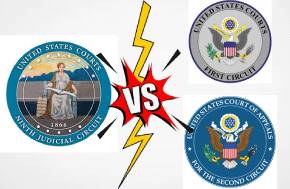
The ruling puts the 9th Circuit squarely at odds with the 1st and 2nd Circuits, both of which have held the opposite. The result is a circuit split that makes Supreme Court review of the issue increasingly likely, and that carries immediate consequences for a $38 billion industry, opens new tab operating across 40 states.
Jumpstart your morning with the latest legal news delivered straight to your inbox from The Daily Docket newsletter. Sign up here.
The question: Does the Constitution protect a market that Congress says shouldn’t exist?
Cannabis regulation in the United States runs on a basic tension. Twenty-four states and the District of Columbia have legalized recreational cannabis use for adults. Meanwhile, 40 states permit some form of medical cannabis. Although rescheduling has been widely discussed, for now cannabis remains a Schedule I controlled substance under the CSA, classified alongside drugs like heroin and deemed to have no accepted medical use.
The disconnect between federal and state law has resulted in a patchwork of state licensing regimes, many of which include residency requirements or preferences for in-state applicants. That protectionism has not gone unnoticed or unchallenged.
Out-of-state operators frozen out of lucrative cannabis markets have filed suit in federal courts across the country, pressing a deceptively simple constitutional question: Can states play favorites in a market that Congress says should not exist at all? Three federal circuits have now weighed in and they do not agree.
Three circuits, two answers
The 1st U.S. Circuit Court of Appeals addressed the issue first in Northeast Patients Group v. United Cannabis Patients & Caregivers of Maine, 45 F.4th 542 (1st Cir. 2022). There, the court concluded that the Dormant Commerce Clause does apply to state-regulated cannabis markets and struck down a provision in Maine’s medical cannabis law requiring that medical dispensary officers and directors be state residents.
In so holding, the court found that an interstate cannabis market exists as a matter of fact (even if cannabis remains federally illegal), and that federal criminalization does not give states license to discriminate against out-of-state economic interests.
The 2nd U.S. Circuit Court of Appeals reached the same conclusion a few years later in Variscite NY Four, LLC v. New York State Cannabis Control Board, 152 F.4th 47 (2d Cir. 2025), when it invalidated New York’s “Extra Priority” cannabis licensing scheme, which favored applicants with New York-specific cannabis convictions (effectively a residency proxy).
The court held that the Dormant Commerce Clause applies despite federal prohibition, reasoning that exempting illegal markets from Dormant Commerce Clause scrutiny would allow states to entrench advantages for their own residents that could distort competition if federal law later changed.
The 9th Circuit went the other way. In Peridot Tree, a three-judge panel considered consolidated challenges to residency requirements in Washington State’s and Sacramento, California’s recreational cannabis licensing schemes.
The plaintiffs — entities majority-owned by a Michigan resident — alleged that they met all substantive licensing criteria except for residency requirements that favored local or in-state applicants. The plaintiffs argued that these residency rules were classic economic protectionism prohibited under Dormant Commerce Clause.
Both trial courts dismissed the claims. The 9th Circuit affirmed, holding that the Dormant Commerce Clause does not apply to state or local laws restricting licensing in a market that Congress has deemed illegal (i.e., state-legal cannabis markets).
In holding that the Dormant Commerce Clause does not apply to state-legal cannabis markets, the panel invoked the Supreme Court’s recent instruction in National Pork Producers Council v. Ross, 598 U.S. 356 (2023) (a Dormant Commerce Clause challenge to California’s ban on selling pork from pigs raised in conditions the state deems “cruel”), that courts should exercise “extreme caution” before deploying the Dormant Commerce Clause.
Read more