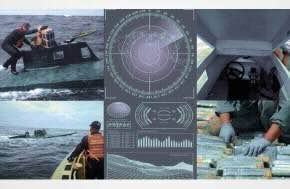
Transnational criminal organizations have crossed a decisive threshold in their industrial evolution. They no longer operate merely as gangs, but as sophisticated networks capable of technological development, specialized outsourcing, and the strategic adoption of digital tools to manage risk.
This qualitative leap has reduced operational friction and increased resilience under pressure from security forces, according to the report, The Subaquatic Frontier of Drug Trafficking, published in Small Wars Journal, by Roberto Uchôa, a former Brazilian Federal Police officer and researcher at the University of Coimbra’s Center for Social Studies in Portugal.
“The transition from adaptive structures to technological ecosystems occurs when innovation ceases to be an episodic reaction to a measure and becomes a permanent component of organizational strategy,” Uchôa, told Diálogo. “In the case of transnational criminal organizations, this threshold is crossed when surplus profits allow for self-financing.”
The shift became evident in July 2025, when the Colombian Navy announced the seizure of the first known unmanned narco-submarine in the Caribbean. The vessel, equipped with a satellite antenna and remote-control capability, was designed to transport up to 1.5 tons of cocaine without a crew.
“The use of autonomous semi-submersibles and advanced cryptographic tools shows that these networks not only consume state-of-the-art technology, but also commission customized engineering solutions,” Uchôa added.
Innovation in the service of drug trafficking
The sophistication of these new smuggling platforms lies partly in their reliance on simple, commercially available technology.
“The autopilot system they use is the same as that installed on a sailboat or recreational yacht; it is completely commercial equipment,” Colombian Navy Commander Víctor Antonio González Badrán, director of the International Center for Research and Analysis Against Maritime Drug Trafficking (CMCON) told Mexican outlet Cambio22. “By not carrying crew, they eliminate the risk of arrests and significantly reduce opportunities for direct pursuit. It is a natural evolution of drug trafficking: less human risk, greater cargo capacity, and remote control from anywhere in the world.”
These vessels can be remotely operated using satellite communications systems, including commercially available broadband terminals. Navigation components, including GPS modules, autopilot systems, and communications equipment, can be purchased on the open market, significantly lowering barriers to entry.
Colombian authorities estimate that navigation systems alone can cost under $6,000, while the total cost of building a semi-submersible vessel typically ranges between $150,000 and $200,000. Yet the cocaine transported aboard such vessels can generate wholesale revenues in Europe worth tens of millions of dollars — profit margins that sustain continued technological investment.
A transatlantic corridor for criminal innovation
The Iberian Peninsula has emerged as a strategic convergence zone, where South American groups interact with European networks, facilitating the exchange of operational knowledge ranging from money laundering techniques to logistics and concealment strategies.
Spanish authorities and analysts increasingly describe this corridor as a testing ground for new smuggling technologies and tactics. Once proven effective, these innovations can be replicated across other global trafficking routes.
“The concept of a ‘transatlantic laboratory’ is accurate,” Uchôa said. “It is in this corridor that new routes and technologies are tested which, if successful, are replicated in other regions of the world. The presence of Balkan and Brazilian organized crime groups in Iberian territory facilitates the exchange of operational doctrines, turning the region into a breeding ground for globalized organized crime.”
Semi-submersible vessels are often abandoned or deliberately scuttled after delivering their cargo, complicating forensic investigations and limiting opportunities for intelligence collection.
Exponential growth in maritime cocaine trafficking
Europol’s January 2026 report, Diversification in Maritime Cocaine Trafficking: Modi Operandi, confirms that cocaine trafficking into Europe continues to expand and diversify.
Read more
Autonomous Narco-Submarines: The New Technological Frontier of Organized Crime