Yes as i read my way through this “article” it seemed to me a bit fishy, a thinly veiled press release for Exilby so i thought to myself let’s just ask google which law firm(s) represent Exilby
I specifically asked “which” law firm(s) rather that saying “Do Clark Hill represent” so as not to create bias within the question posed .
And, yes indeed, it is a thinly veiled press release.
I have no specific issue with them writing this but i do not see anywhere on this page that there is a declaration that Clark Hill act for Exilby.
Google AI Says
- The Manufacturer: Exilby (VER-01) is a standardized, full-spectrum cannabis extract. It was developed by the Munich-based biopharmaceutical company, Vertanical. [1, 2]
- The Legal Support: Clark Hill handles and reports on the complex global regulatory milestones for the drug. This includes navigating its historic market authorizations and fast-tracked approvals across different countries. [1, 2]
- Germany & Austria: The drug recently received regular market authorization to treat chronic low back pain. It is celebrated as the first cannabis-based finished medicine approved for this in Europe. [1, 2]
- United States: The U.S. Food and Drug Administration (FDA) granted Exilby a Breakthrough Therapy Designation to speed up its development. Vertanical is currently running Phase 3 trials in the U.S. with plans to submit a New Drug Application by 2028. [1, 3]
So next question who is Karl Frederic and it transpires that actually he’s their PR dude, sorry I meant Senior Director, Clark Hill Public Strategies, and not a lawyer.
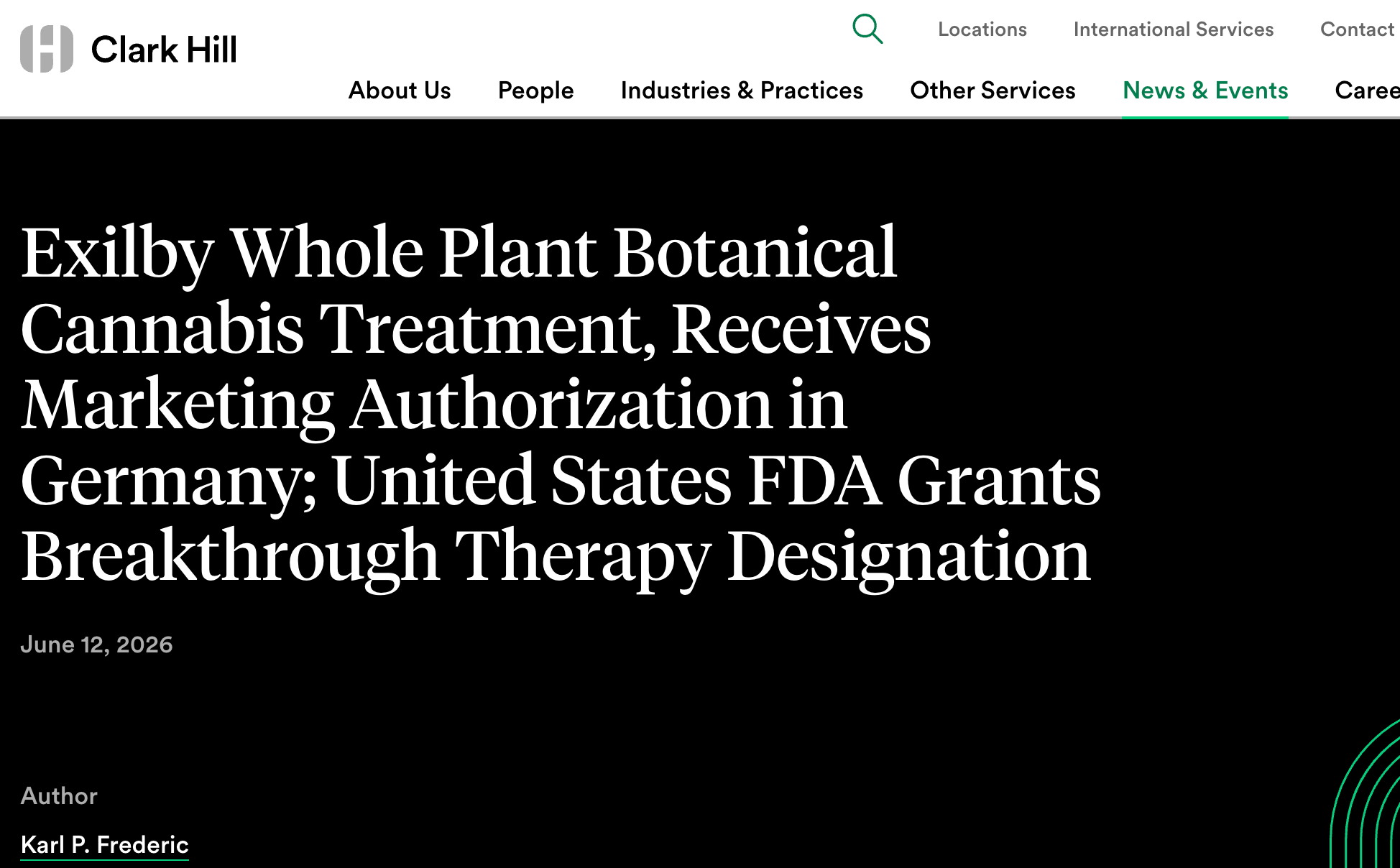

As somebody who reads this stuff daily it’s an unsaid that when a law firm publishes an article it is 99.9999% likely that it is written by a lawyer, usually a junior one who has to defer their partner who quickly skim reads the article and says ok that’s fine for publication, just remember I wrote it and you assisted me!
Some of you may say, stop nitpacking, but it’s the thin end of the wedge and it’s sloppy, very sloppy.
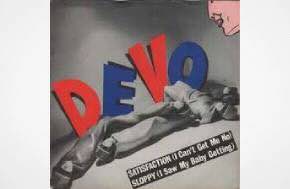
Per our header Image, I can’t get no satisfaction from this post because as the B-side reveals … you can look it up.
Make your own mind up below

Author
In a series of major industry milestones, this week it was announced that the investigational drug Exilby, a standardized full-spectrum extract from a proprietary cannabis strain, has received marketing authorization from Germany for the treatment of chronic low back pain with a neuropathic component while late last month the United States Food & Drug Administration granted the medicine a Breakthrough Therapy Designation intended to expedite the development and evaluation of the drug. It is positioned as the first non-opiate chronic pain treatment of its kind worldwide.
Developed under the name VER-01 by the Munich-based company Vertanical, Exilby is derived from proprietary plant genetics selected to consistently include a defined mixture of cannabinoids, terpenes and other bioactive compounds that were identified as potentially relevant to pain modulation and associated symptoms. According to the manufacturer’s website, the German marketing authorization and US FDA designation were granted after two randomized, controlled Phase 3 trials involving more than 1,200 patients demonstrated significant pain reduction, a favorable tolerability profile and no evidence of dependence. In a direct Phase 3 head-to head comparator study pitting Exilby against opioids (as opposed to placebo in standard studies), Exilby demonstrated superior pain reduction and better gastrointestinal tolerability than opiates.
This moment is reminiscent of the FDA approval of Epidiolex in 2018 as the first plant derived cannabis medication made available by prescription to treat a range of rare and severe seizure disorders with its active ingredient CBD. Exilby, as a non-opiate therapy for chronic pain, has the potential to address a vastly larger market and greatly eclipse the $100 Million in annual sales generated by Epidiolex. Epidiolex differs from Exilby in that the seizure medication is a single purified CBD compound while Exilby is a full-spectrum extract containing over 100 compounds featuring a number of cannabinoids, including THC, CBD and CBG.
The marketing approval of Exilby is being widely hailed as a major therapeutic innovation in the management of chronic pain, an ailment that is estimated to afflict 1 Billion people worldwide, including 10 Million Germans and 60 Million Americans. The drug is believed to be the first truly new pharmacological option to treat chronic pain in 15 years.
Vertanical is expected to launch Exilby in Germany and Austria in September. The European Union has mutual recognition procedures for pharmaceutical products that provides a regulatory pathway for approval for the broader availability of Exilby throughout the EU in a matter of weeks. The company expects to submit the drug to the United Kingdom’s Medicines and Healthcare products Regulatory Agency later this year, targeting marketing approval in the UK before year-end.
In the United States, Exilby has a longer and more challenging regulatory pathway to navigate. Vertanical has initiated a Phase 3 study with US patients to establish the safety and efficacy of the drug in the treatment of chronic low back pain. The company anticipates the results of the US trial to become available for review and analysis in 2027, if the outcome is positive, plans to submit a New Drug Application to the FDA in 2028.
Clark Hill Commentary
The approval of Exilby, a full-spectrum botanically-derived cannabis pharmaceutical product, for marketing in Germany and Austria with the balance of the EU and UK shortly to follow, is the latest in a cascade of positive milestones for the legal marijuana industry.
When the Controlled Substances Act was enacted in 1970, cannabis was classified as a Schedule I controlled substance, meaning that the drug had a high potential for abuse, no currently accepted medical use in treatment and a lack of accepted safety for use of the drug under medical supervision. While the headline heralds the new availability of a breakthrough treatment for the management of pain and a potential blockbuster pharmaceutical product, the data from the rigorous clinical trials, particularly the head-to-head comparison with opioids establishing cannabis as the more effective non-addictive remedy, refutes the conclusions that led to marijuana being placed on Schedule I.
The expected uphill path for regulatory approval of Exilby in the US has been at least partially leveled by the prior approval of a botanically-derived cannabis therapy—Epidiolex—and the recent rescheduling of marijuana products that are approved by the FDA. The major presently foreseeable challenge to FDA approval is that unlike Epidiolex that had only one CBD compound, the VER-01 extract contains over 100 compounds so that meeting the rigorous product safety criteria will present different issues for the manufacturer seeking approval to bring the drug to the US market. Under FDA regulations, each compound in the proposed medication must be evaluated for its effects, interactions, and potential risks, increasing the complexity, time and expense for the applicant.
For more on the recent rescheduling of marijuana, please go to the Clark Hill webisode on the implications of cannabis rescheduling from our members Craig Small and Karl Frederic at Cannabis Video Series | Clark Hill PLC.
This publication is intended for general informational purposes only and does not constitute legal advice or a solicitation to provide legal services. The information in this publication is not intended to create, and receipt of it does not constitute, a lawyer-client relationship. Readers should not act upon this information without seeking professional legal counsel. The views and opinions expressed herein represent those of the individual authors only and are not necessarily the views of Clark Hill PLC. Although we attempt to ensure that postings on our website are complete, accurate, and up to date, we assume no responsibility for their completeness, accuracy, or timeliness.