There’s a whole book to be written here.
Thankyou Chronicles of Kykeon
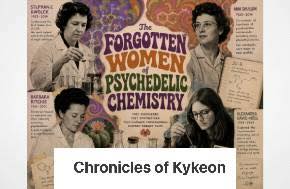
The history of psychedelics, as it’s usually told, is a story about men. Who hasn’t heard of Albert Hofmann, Alexander Shulgin, and Timothy Leary? There’s a reason every one of those names is male, and it has nothing to do with who actually did the work.
Behind some of the most important discoveries in psychedelic chemistry, there were women who were the researchers, the collaborators, the synthesizers, and the field testers. They kept the notebooks, ran the experiments, wrote the papers, and then watched their names get quietly dropped from the narrative.
Ann Shulgin didn’t just marry a chemist. She was the laboratory.
When Alexander Shulgin was synthesizing novel phenethylamines and tryptamines in his backyard lab in California, Ann was his primary psychedelic test subject, his integration guide, and his co-author. PiHKAL and TiHKAL, the two-volume opus that functions as both memoir and synthesis manual, carry both names on the cover. But in the psychedelic community’s retelling, Sasha gets the genius mantle and Ann gets described as his wife.
Ann was a therapist with decades of underground MDMA-assisted session work before that was a clinical trial or a press release. She trained guides, documented outcomes, and built protocols. When the field of psychedelic-assisted therapy talks about its therapeutic roots, it’s drawing directly from methods Ann helped develop. It just doesn’t always say so.
Melissa Cargill worked in Owsley’s lab. That sentence alone should be enough.
Owsley Stanley is a legend in psychedelic history as the underground chemist who produced an estimated 500,000 doses of LSD between 1965 and 1967. What gets mentioned less often is that Melissa Cargill, a chemistry student with real laboratory skills, collaborated with him throughout that period. She wasn’t a groupie, and she wasn’t a muse. She was in the lab, handling synthesis and managing the technical operation that made Owsley’s output possible at scale.
Cargill eventually left the psychedelic underground, went straight, and built a life far from the counterculture mythology that swallowed her early years whole. That exit made her easier to forget as there was no memoir, no speaking circuit, and no legacy brand to maintain. Owsley became a folk hero while Cargill became a footnote. The asymmetry is almost perfect. The man who made the drugs is immortalized, the woman who helped make them possible quietly disappears from the record.
Go back further, and the erasure gets worse.
In the 1950s, a Canadian nurse named Harriet Kling worked alongside Humphry Osmond and Abram Hoffer at the Saskatchewan mental hospital where some of the earliest clinical LSD research in North America was conducted. Osmond and Hoffer became famous. Kling administered the sessions, held patients through harrowing experiences, and recorded the data that made the research publishable. Her name appears in a handful of footnotes.
Then there’s the matter of Marie Curie’s intellectual granddaughters.
The women who moved through mid-century psychedelic research often did so under the cover of technical roles and were named as lab assistants, research nurses, and data collectors. The male physicians and chemists took credit for findings they couldn’t have reached alone. This wasn’t unique to psychedelics. It was the operating model of science in the postwar decades. What made it worse in the psychedelic field was the secrecy involved. Underground work leaves no institutional record, just the memory of the people who were there.
Some women didn’t just contribute, they led.
Helen Mayberg isn’t a psychedelic researcher, but she’s an instructive case. A neuroscientist whose foundational work on depression circuitry was overlooked for years while male colleagues collected the citations. The pattern repeats. In the 1960s and 70s, numerous women in the orbit of Millbrook and the early San Francisco psychedelic scene were doing serious philosophical and psychological work around these compounds. They mapped the terrain of consciousness and developed therapeutic frameworks. What they produced was absorbed into the culture without attribution.
The Renaissance isn’t much better. Not yet.
The current psychedelic renaissance driven by MAPS, Johns Hopkins, NYU, and the rest of the whole clinical apparatus has made some gestures toward inclusion. Women lead several major research programs. The therapy-training world is heavily female. But the names that get attached to the movement’s founding mythology are still mostly men.
That matters because mythology shapes funding, shapes credit, and shapes who gets to define what the field is for. The forgotten women of psychedelic chemistry weren’t peripheral. They were central as they synthesized compounds, guided sessions, trained therapists, and wrote protocols. In some cases they kept the entire enterprise from collapsing. The least we can do is say their names.
Start with Ann Shulgin, then go looking for the rest. There are more than you think.