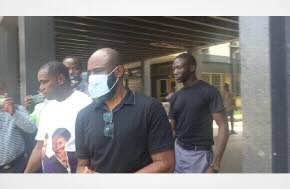
The Monrovia City Court has found sufficient evidence to forward Global Logistics Services (GLS) Operations Manager Paul J. King and several co-defendants to Criminal Court “C” for trial in the landmark US$19.2 million cocaine trafficking case.
In a ruling delivered on Monday, Stipendiary Magistrate Ben Barco held that prosecutors from the Ministry of Justice and the Liberia Drug Enforcement Agency (LDEA) had established probable cause to prosecute the defendants under Liberia’s Amended Controlled Drugs and Substances Act.
The ruling marks a significant development in one of the country’s largest narcotics prosecutions, clearing the way for a full criminal trial.
However, the court’s decision has also drawn attention to the absence of the alleged shipper of the intercepted consignment from the current indictment, despite the individual being identified in investigative documents presented during the preliminary examination.
King has been charged alongside Michael U.S. Brown, Raheem Ousman Ali, Oscar Brown, Emmanuel Kpeh, and others yet to be identified.
The ruling followed weeks of preliminary hearings during which state prosecutors presented witnesses, documentary evidence, and investigative findings linking the accused to an alleged attempt to traffic cocaine through Roberts International Airport (RIA).
Magistrate Barco ruled that the prosecution had met the legal standard required at the preliminary stage.
“The court finds that probable cause exists. The evidence adduced so far, if unrebutted, is sufficient to warrant the defendants to answer to the charges of drug trafficking,” the magistrate ruled.
The court emphasized that a finding of probable cause does not amount to a conviction but merely establishes that sufficient evidence exists for the defendants to stand trial.
The defendants have pleaded not guilty to charges including unlawful possession, importation, conspiracy, and trafficking of controlled narcotic substances.
Lead defense counsel Cllr. Amara Sheriff argued that the prosecution’s evidence was largely circumstantial and insufficient to sustain the charges. He subsequently sought bail for his clients and vowed to challenge the government’s case during trial.
Under Liberia’s amended anti-drug law, trafficking narcotics above the statutory threshold is classified as a non-bailable offense and carries severe penalties, including lengthy prison terms and substantial fines upon conviction.