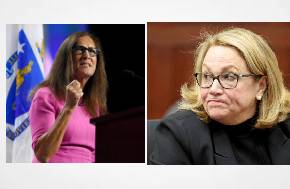
Shannon O’Brien today sued state Treasurer Deb Goldberg and the Cannabis Control Commission over the way O’Brien was forced out of her job as commission chair – charging Goldberg violated her civil rights, illegally used her power as a state official to get confidential, private information to smear her and completely ignored her rights under the state whistleblower act.
In her suit, filed this afternoon in Suffolk Superior Court, O’Brien is seeking at least $3 million for lost wages, emotional distress, damage to her reputation and the costs of legal representation in her fight to get back her job, which she did, until the legislature reorganized the commission earlier this year and she lost her seat for good. However, that amount does not include the punitive damages she says she is owed and attorney’s fees for bringing the suit.
This case concerns what happened after Shannon O’Brien did the job she was appointed to do. Following her appointment as Chair, Ms. O’Brien confronted entrenched management failures at the Cannabis Control Commission, insisted that credible allegations of regulatory misconduct be investigated, and opposed conduct she reasonably believed violated Massachusetts law and endangered the public. The retaliatory response was swift: pressure to resign, misuse of confidential personnel processes, suspension, and ultimately removal from office.
O’Brien – herself a former state treasurer – says Goldberg recruited her in 2022 to reform the troubled state agency, but that Goldberg and her allies/moles in the commission quickly moved against her when she tried to do just that.
O’Brien took that mandate seriously. She demanded accurate information, competent management, evenhanded enforcement, and meaningful investigation of serious allegations – including that a favored licensee was cultivating and distributing unregulated cannabis, using an underage person to help manufacturer cannabis products, and receiving preferential treatment.
Those efforts threatened senior Commission officials whose performance, conduct, and relationships O’Brien had begun to scrutinize. Rather than address the problems she identified, they used the Commission’s personnel machinery to discredit the Chair and drive her from office.
The complaint adds:
Goldberg knew that O’Brien was reporting and opposing government misconduct, communicating with public bodies, seeking judicial relief, and refusing to surrender a statutory office from which she could only be removed for cause.
Goldberg used threats, intimidation, and coercion to make O’Brien abandon those rights. Among other things, she disclosed confidential accusations to a political associate, communicated that O’Brien would be humiliated and replaced, pressured her to resign before the investigation was complete, and conveyed that refusal would result in suspension.
At particular issue, O’Brien charges, were the activities of commission Executive Director and acting General Counsel Shawn Collins, and the activities of a marijuana grower called Greatest Hits that was doing illegal stuff, including hiring an underage employee to work with marijuana.
In fact, she charges, the two issues were related: She avers she directed Collins to begin looking into the allegations against Greatest Hits – and that Collins never told her he was best buds with the company’s lawyer, in fact, he had had him as a groomsman at his wedding, or that the man in charge of compliance at the company had previously worked at the commission under Collins’s direction.
O’Brien later received information that Collins had interfered in or obstructed the investigation of Greatest Hits; that assigned investigators had been replaced; and that meaningful enforcement action was delayed while evidence could be removed.
Although the state whistleblower act is normally cited by lower-level employees, not the head of a government agency, O’Brien says it covers her because after awhile, she began sending information about the company and the commission to the state Office of the Inspector General, the state auditor and the US Attorney’s office in Boston.