Abstract
Cannabis use is rapidly increasing across the United States following widespread legalization. This trend poses new challenges in perioperative management due to complex pharmacologic and physiologic effects. This review summarizes current knowledge on cannabis interactions with anesthetic agents and highlights associated cardiovascular, respiratory, and gastrointestinal risks. Professional recommendations and best practices are discussed to assist perioperative teams in safely managing patients with recent or chronic cannabis exposure.
Introduction
Cannabis use is increasing nationwide with the legalization of medical and recreational marijuana in nearly half of the United States and the District of Columbia. This movement toward legalization is at the state and local levels, while at the federal level, cannabis is still considered criminal. Cannabis is used either for medical use to manage symptoms of many diseases or as a recreational drug. Routes of administration include inhalation, transdermal, and oral intake. As recreational cannabis use becomes more common, it is increasingly important for physicians to understand how cannabis affects the body and interacts with other drugs. With more patients presenting for surgery, potentially under the influence of cannabis, anesthesiologists and surgeons are facing complex, under-researched challenges. In this article, we will explore some of the concerns of cannabis use in the perioperative environment (Table 1).
The pharmacologic puzzle: cannabis and anesthetic agents
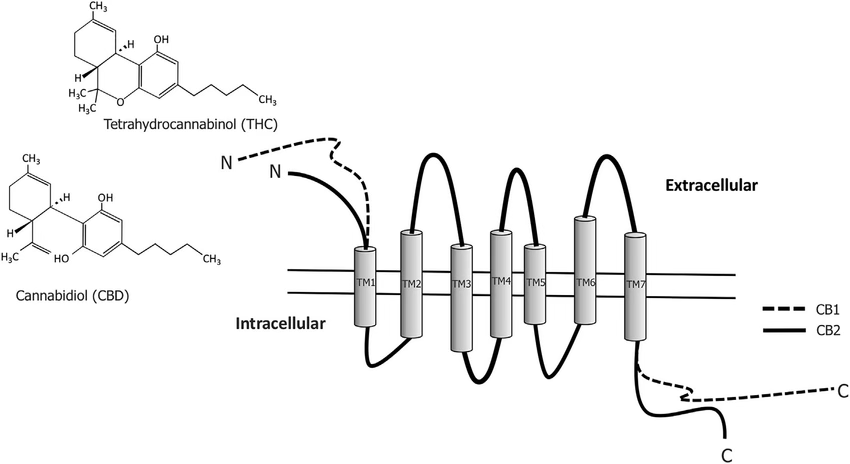
The effects of cannabis with anesthetic agents are highly variable and not yet fully understood. Commercially available cannabis products can elicit a wide array of physiologic effects, largely dependent on the product’s chemical composition, an individual’s unique biology, and the method of consumption. The primary psychoactive compound, delta-9-tetrahydrocannabinol (THC), and the non-psychoactive compound, cannabidiol (CBD), are key drivers of these effects, alongside other cannabinoids and terpenes present in the plant (Fig. 1). Variations in cannabinoid concentration, product formulation, potency of various crops, quality control, individual physiology, and tolerance contribute to unpredictable anesthetic responses.
Cannabinoids bind to CB1 receptors predominantly in the brain and CB2 receptors predominantly in peripheral nerve terminals and immune cells (Fig. 1). CB1 receptors are involved in modulating release of neurotransmitters such as GABA, dopamine, and norepinephrine. CB1 receptors are also involved in memory, appetite, and pain perception. CB2 receptors modulate the immune system, reducing inflammation and pain. THC can act as an antagonist or an agonist of CB1 and CB2 receptors depending on tissue location and ligand availability. CBD acts as an inverse agonist of the CB2 receptor leading to reduced inflammation. Even more complexity is added when using highly potent concentrates which may include other synthetic cannabinoids. Chronic cannabis use has been linked to increased dose requirements of anesthetic agents like propofol and thiopental to achieve anesthesia, while acute or occasional use may enhance sedative sensitivity, increasing the risk of oversedation.
Figure 1: CB1 and CB2 receptor and chemical form of THC and CBD
Schematic showing the CB1 and CB2 cannabinoid receptors and the chemical form of THC and CBD.
Hemodynamic hazards: cardiovascular effects of cannabis
Tachycardia is a commonly found effect of cannabis use. New or occasional cannabis users can experience hypertension, atrial fibrillation, ventricular tachycardia, and ventricular fibrillation. These effects are largely mediated by CB1 receptor-induced modulation of sympathetic and parasympathetic tone, leading to catecholamine fluctuations. These fluctuations in norepinephrine and epinephrine can complicate intraoperative management. Cannabis has also been implicated in unmasking Brugada syndrome through sodium channel modulation, increasing the risk of malignant arrhythmias. Brugada syndrome is an autosomal dominant genetic heart condition which increases the risk of life-threatening arrhythmias and sudden cardiac arrest. Brugada pattern on ECG shows pseudo right bundle branch block and ST elevations in V1-V3. While these patients are usually asymptomatic, cannabis can unmask symptoms and lead to life-threatening arrhythmias. Care should be taken to anticipate these hemodynamic changes and be ready for any potential cardiovascular events in the OR.
Respiratory risks: cannabis and airway management
It should be of no surprise that smoking marijuana can negatively impact the lungs. There is evidence that both inhaled and ingested cannabis can acutely lead to bronchodilation and decreased airway resistance. However, patients who inhale marijuana regularly can develop airway edema, increased bronchial reactivity, or upper airway obstruction. All of these are scenarios that can complicate intubation or extubation. Clinicians should anticipate laryngospasm or bronchospasm, especially during airway manipulation in cannabis users.
Gastrointestinal implications: delayed gastric emptying and aspiration risk
Most are familiar with cannabis’ link to increased appetite and food intake. Cannabis use is also associated with decreased gastric emptying and peristalsis likely via CB1 receptors in the enteric nervous system. Cannabis has been linked to gastroparesis. This means that even if a patient has fasted for more than eight hours, there could still be unexpected stomach contents remaining at the time of surgery. This places these patients at increased risk of vomiting and pulmonary aspiration while under anesthesia. Point-of-care gastric ultrasound in addition to thorough history is being explored as a tool to assess for potential delayed gastric emptying and risks of aspiration. However, more research is needed to understand its validity and utility in assessing this risk in cannabis users.
Table 1: Summary of perioperative risks of cannabis use
This table summarizes acute and chronic cannabis use implications across major physiologic systems.
| Domain | Acute/occasional use | Chronic/heavy use | Perioperative implications |
|---|---|---|---|
| Anesthetic requirements | Increased sensitivity to sedatives, with risk of oversedation | Increased induction dose requirements (e.g., propofol, thiopental) | Adjust dosing carefully based on use history |
| Cardiovascular | Tachycardia, hypertension, atrial fibrillation, risk of ventricular arrhythmias | Chronic sympathetic stimulation may blunt typical responses; increased long-term cardiac risk | Continuous monitoring, anticipate arrhythmias |
| Respiratory | Acute bronchodilation but increased risk of airway reactivity if smoked | Airway edema, chronic bronchitis, increased bronchospasm risk | Anticipate difficult intubation or extubation |
| Gastrointestinal | Delayed gastric emptying, increased aspiration risk even after fasting | Gastroparesis, cannabinoid hyperemesis syndrome | Consider gastric ultrasound; treat as high aspiration risk |
| Other | Impaired cognition, anxiety, paranoia intraoperatively and postoperatively | Tolerance, withdrawal risk (agitation, insomnia) | Preoperative counseling and careful monitoring |
Professional recommendations
The American Society for Regional Anesthesia and Pain Medicine (ASRA Pain Medicine) and the Society for Perioperative Assessment and Quality Improvement (SPAQI) recommend that elective surgery should be delayed for at least three days after cannabis use, with a longer abstinence period (up to two weeks) preferred for heavy smokers to reduce airway irritability. Patients should abstain from cannabis beginning at midnight before surgery to avoid acute intoxication and minimize withdrawal risk in chronic users. Abrupt cessation within six days of surgery is discouraged in heavy users due to the risk of withdrawal symptoms. For edible cannabis users, some experts recommend up to ten days of abstinence. This recommendation is based on pharmacokinetics rather than clinical outcomes. There is a lack of high-quality evidence regarding the optimal duration of abstinence prior to anesthesia, precise dose adjustments for anesthetic agents, and management strategies for non-inhaled cannabis products. There is no universal consensus on the exact safe interval and recommendations vary. Further research is needed to clarify optimal timing, especially for chronic users and for different routes of administration.
Best practices for the OR team
- Routinely ask about cannabis use, frequency, and route.
- Delay elective cases if recent use is confirmed.
- Adjust anesthetic dosing based on use patterns.
- Anticipate airway and cardiovascular complications.
Guidance for patients: what you should know before surgery
- Be honest with your surgical team about cannabis use.
- Disclose frequency, amount, and route of administration (e.g., ingested, inhaled, transdermal).
- Avoid cannabis use prior to elective surgery if possible.
- Ask questions and discuss any concerns with your physician.
Conclusion: a high-stakes situation
Although cannabis use is legal in many states, it is not pharmacologically benign, especially in the OR. Cannabis use has complex implications in the perioperative setting, influencing anesthetic requirements and cardiopulmonary stability. The pathophysiological effects of cannabis involve multiple systems, including respiratory, cardiovascular, and gastrointestinal systems. These effects can dramatically influence perioperative management and have significant potential to elevate the perioperative risk. As legalization expands, OR teams should approach cannabis users with proper planning and vigilance to avoid intraoperative cardiovascular and respiratory morbidity and mortality.
Jannea Vance is a fourth-year medical student at Ross University School of Medicine, affiliated with Trinity Health Oakland. She earned a Bachelor of Science in exercise science from the University of Mississippi, a Master of Science in biology from Mississippi College, and a Master of Science in biomedical sciences from the University of Mississippi Medical Center.
During her graduate training at Mississippi College, she completed a multi-semester thesis examining attentional and memory biases to threatening information in students with test anxiety. Before medical school, she spent several years in health care operations, managing clinical scribe programs across multiple health systems. She later worked with Microsoft+Nuance Communications, supporting the implementation and operational integration of DAX AI clinical documentation technology across health care systems.
Her interests include clinical research, patient advocacy, health care systems and policy, and emerging health care technology. She can be found on LinkedIn.
Zulfiqar Ahmed is a pediatric anesthesiologist.
Source: https://kevinmd.com/2026/08/why-cannabis-and-anesthesia-are-a-high-risk-combination.html