
Tenerife weekly report this.
They don’t mention their source but i found the report via
He’s still working with Swedish lawyer Lars Olofsson, as his profile picture clearly states.
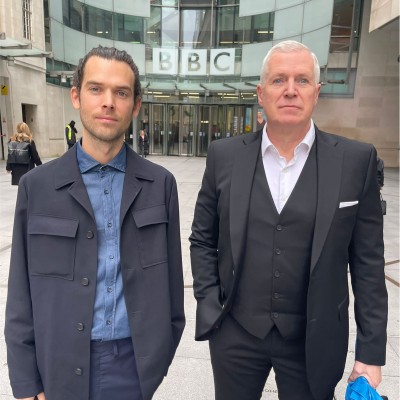
I’m surmising some of the info came from them as Johansson writes on LI.. There is still much of this story no media has published if anyone is interesed to know more feel free to reach out
They need to cheer up a bit . I know being an international crime fighter is arduous work but look even Bruce Wayne had the odd moment of levity.
Risk is our Business Mr Wayne!
That said it is very sad to see that money scammed in western europe is then used in part to fund the murder of ukrainians. The 21st century is certainly competing well with the last one for unpleasantness if this is indeed the case
The report
The promise of becoming wealthy by investing in cannabis plantations through the Ponzi scheme Juicy Fields concealed an unimaginable backdrop for those who lost their savings in the venture: a significant portion of the embezzled money ended up being allocated to a drone factory belonging to the Russian Defence Ministry.
One of the masterminds of the scheme, Sergei Berezin, stated on 11 November before Judge Antonio Piña of the National Audience that nearly half of the €645 million embezzled was allocated to a drone factory in Saint Petersburg, according to sources present at the hearing.
Berezin’s confession, extradited to Spain after his arrest in April 2024 in the Dominican Republic, where he was hiding under a false identity, supports what some investigators have long suspected: the largest pyramid scheme in Europe had Kremlin backing, involving agents linked to Russian intelligence services and the Wagner mercenary group.
The Juicy Fields fraud was exposed by elDiario.es in a report in May 2022 and, just two months later, its leaders vanished, taking all the money with them.
The company, which once had a headquarters in Valencia, promised substantial returns (of up to 160%) for investing in supposed medicinal cannabis plantations that later turned out to be nonexistent. It is estimated that up to 180,000 investors were affected, losing hundreds of millions of euros overnight.
Berezin’s voluntary statement before the judge has marked a turning point in the investigation. For the first time, the alleged ringleader of the scheme admitted that there were never any profits from the cannabis plantations and that, out of the €645 million stolen, only about €30 million were allocated to hiring staff, devising marketing strategies, and financing crops to give an appearance of credibility to the business.
Berezin initially claimed before the investigating judge that he was merely a translator with marketing knowledge. However, three hours later, he admitted that he was making substantial decisions within the organisation. He named four individuals who led half of the fraud and claimed that the other half was managed by “hidden partners” in Russia whose identities he refused to disclose.

Links Between Juicy Fields and the Kremlin
In September 2017, CIA agents delivered a suitcase containing $100,000 to a mysterious Russian citizen in a hotel room in Berlin, claiming to be linked to the Kremlin and the organised crime underworld of Saint Petersburg.
The payment was to be the first of several transfers, amounting to a million dollars, agreed upon in exchange for previously stolen cybersecurity tools from the US National Security Agency (NSA). The deal also included the delivery of a supposed video of Donald Trump with prostitutes in a Moscow hotel.
During the meetings held prior to the payment, the mysterious Kremlin envoy even summoned the American agents to the Russian embassy in Berlin to negotiate the agreement. However, after the first payment, the CIA agents realised it was a scam and severed ties, as reported by the New York Times.
The man was named Viktor Bitner, as confirmed by investigation sources, and he is the same individual who registered Juicy Fields’ first company in Berlin in November 2019.
This case is one of several threads connecting Juicy Fields’ leadership to the Kremlin, highlighting how organised crime and the Russian state have become interconnected.
“The line separating one world from the other is very thin,” points out Federico Varese, a criminologist at the University of Oxford and an expert on Russian organised crime. “Criminals can operate independently as long as they do what the Kremlin wants.”
Europol itself warns in a 2025 report about the “shadow alliance” between criminal gangs and the Russian state. According to this European police agency, Russia leverages “the resources, expertise, and protection” of these organisations to achieve its objectives. “Online fraud has reached epidemic levels,” adds the same report.
According to Varese, a scam like Juicy Fields could not have originated in Russia without government acquiescence. “It’s practically impossible,” he asserts in a phone conversation.
It is also not surprising to him that part of the stolen money ended up in a drone factory. “There has been a criminalisation of the Russian economy since the war,” this expert points out, while recalling some companies’ strategies to evade sanctions. “And there is an integration between the criminal world and the state’s efforts for the war in Ukraine.”
Business records confirm that Vitaly Markevich, considered the ‘number two’ of the scam and mentioned this November before the judge by Sergei Berezin, is linked to the aforementioned drone company located in Saint Petersburg. According to a consortium of media that investigated the fraud, the company had the Russian Defence Ministry’s logo on its website.
Markevich, 41, managed to escape the large international operation — involving up to 400 agents from Spain, France, and Germany — that resulted in several searches and arrests worldwide. He was registered at the Russian House in Berlin, a cultural centre managed by an organisation linked to the Russian Foreign Ministry. However, by the time agents arrived, Markevich had vanished.

The connections do not end with the Russian drone company. The former security chief of Juicy Fields, Igor Kekshin, is a former police officer from Saint Petersburg who worked for the Wagner mercenary group after being released from prison for kidnapping, extortion, and illegal detention.
Kekshin is one of the informants of the fraud and testified before the police in Berlin for three days. He subsequently disappeared and uploaded a video claiming that everything he had said was a lie.
The information he revealed was, in any case, valuable. He was the one who warned that the alleged leader of Juicy Fields arrested in the Dominican Republic had previously run a similar fraud in Poland called Reciklix.
His main frontman in that earlier scam, a Lithuanian named Aleksandr Suranovas, was arrested last summer for sending packages containing explosives through DHL. He is accused of working for the GRU, the Russian military intelligence agency, according to the Wall Street Journal.

The Difficulty in Apprehending Other Fugitives
The instruction of the case is progressing slowly in the National Audience due to the complexity of the fraud. Meanwhile, the Berlin prosecutor’s office is also conducting its own investigation, which, according to legal sources, could lead to a jurisdictional conflict over who ultimately retains the case.
Legal sources on both sides highlight the difficulty of continuing investigations when probing suspects who have managed to flee to Russia. “It is an insurmountable wall,” they point out.
“Unfortunately, the geopolitical conflict between Russia and the West means that no Russian criminal can be prosecuted if they are in that country,” explains Varese, the Oxford expert. “Russia protects these criminals.”
Among those prosecuted are some of the alleged ringleaders of the fraud, but there is also a significant number of company employees who claim they were unaware that it was all a scam.

Some have received death threats, graffiti on their homes, and even fake bomb packages to prevent them from revealing the secrets of the fraud that remain to be disclosed.
Meanwhile, Berezin has offered to collaborate with the authorities. He assured the investigating judge that he would provide documents and recordings to aid in the investigation. He also offered to contribute assets worth over €15 million to compensate victims, a sum far below the €645 million that the investigation believes was ultimately stolen.
The Funds from the Juicy Fields Scam Ended Up in a Kremlin Drone Factory