US Hemp Roundtable
|
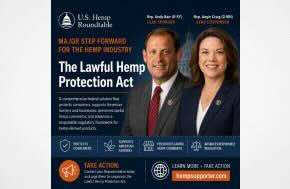
Today, Reps. Andy Barr (R-KY) and Angie Craig (D-MN) formally introduced the bipartisan Lawful Hemp Protection Act, comprehensive federal legislation designed to preserve lawful hemp commerce while establishing a long-awaited national regulatory framework for hemp-derived consumer products.
The legislation represents one of the most significant federal hemp policy developments since passage of the 2018 Farm Bill and comes at a critical moment for the industry, as the federal hemp ban language enacted in the fiscal year 2026 agriculture appropriations law remains scheduled to take effect this November. Rather than prohibiting hemp products outright, the Lawful Hemp Protection Act takes a regulatory approach by establishing a federal framework for labeling, packaging, age restrictions, product standards, cannabinoid oversight, and domestic sourcing requirements, while preserving lawful hemp commerce and recognizing the importance of consumer access to compliant products.
Importantly, the bill would revise the federal definition of hemp to move away from the unworkable 0.4 mg total THC per container standard currently scheduled to take effect in November. Instead, the legislation directs FDA to establish serving limits through rulemaking and scientific review. If FDA does not act within one year, the bill establishes serving limits of 5 mg THC for ingestible products, 50 mg THC for inhalable products, and 50 mg THC for topical products. The legislation also includes provisions addressing synthetic cannabinoids, FDA oversight, labeling requirements, age verification, impaired driving enforcement, hemp-derived beverages, and interstate commerce protections.
Among other things, the Lawful Hemp Protection Act would:
- Create a federal pathway for hemp-derived consumable products to be regulated within a lawful framework;
- Establish federal labeling and packaging requirements;
- Require 21+ labeling and age-verification requirements for hemp-derived consumable products;
- Require that hemp-derived cannabinoid products be derived exclusively from hemp cultivated, processed, finished, packaged, and labeled in the United States;
- Create a federal TTB permitting, registration, and oversight structure for manufacturers of hemp-derived cannabinoid products and wholesalers of hemp-derived beverages;
- Prohibit synthetic and artificially modified cannabinoids and other non-naturally occurring compounds, such Impose a milligram-based excise tax on hemp-derived beverages of 5 cents per milligram of THC, a 5 percent tax on the sale price of other hemp-derived cannabinoid products, and a 5 percent tax on the sales revenue of manufacturers;
- Establish a three-tiered distribution system for hemp-derived beverages, separating manufacturers, wholesalers, and retailers;
- Allow hemp-derived cannabinoid products to be covered as a special supplemental benefit under Medicare Advantage;
- Preserve interstate transportation of compliant hemp products; and
- Allow states, territories, and Tribes to continue enacting their own regulations that are more stringent than federal law.
The U.S. Hemp Roundtable applauds Reps. Andy Barr and Angie Craig for advancing a bipartisan, science-based solution and for engaging stakeholders across the hemp industry throughout the drafting process. Their leadership reflects a recognition that prohibition is the wrong path and that consumers, farmers, retailers, manufacturers, and small businesses deserve a workable federal regulatory framework.
The Roundtable continues to advocate for several key policy priorities that have guided our engagement throughout this process, including:
- Reasonable, science-based serving limits;
- Strong consumer protections and age restrictions;
- Clear federal regulatory pathways for compliant products;
- Protection against dangerous synthetic cannabinoids;
- Preservation of interstate commerce; and
- Avoidance of overly burdensome taxation or distribution requirements that could unnecessarily harm small businesses and consumers
The introduction of the Lawful Hemp Protection Act marks a major step toward replacing prohibition with regulation and advancing a long-term federal solution for hemp farmers, businesses, retailers, and consumers.