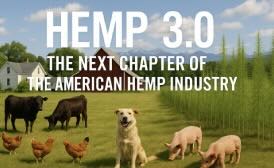
The U.S. hemp industry has gone through distinct eras over the past decade, each defined by legislation, regulation, or the lack of it, and the market realities that followed. Today, the industry stands at the threshold of a new era. That era is Hemp 3.0.
Hemp 1.0 began in the years before and immediately after the 2014 Farm Bill. For the first time in decades, hemp was allowed back into American fields under state pilot programs. Small-scale crops, research plots, and early entrepreneurial efforts marked the reintroduction of a plant long celebrated for its versatility. With little infrastructure and limited regulatory clarity, the industry’s potential remained largely aspirational.
Hemp 2.0 arrived with the 2018 Farm Bill, which federally legalized hemp and its derivatives. The law triggered a rush into cannabinoids, especially CBD, without a clear federal pathway for manufacturing, marketing, or sales. Oversupply followed, prices fell, and in the absence of guidance, non-intoxicating products blurred into intoxicating derivatives such as delta-8 THC. At the same time, fiber and grain were treated as an afterthought, bundled with cannabinoid policy and blocked from developing the infrastructure, markets, and standards needed to scale. The global Covid pandemic added pressure by disrupting supply chains, drying up capital, and stalling early momentum. On the policy front, neither the Trump nor Biden administrations delivered the regulatory clarity the industry needed. Biden’s climate-smart initiatives were a bright spot that supported fiber and grain, but many of those gains were rolled back when Trump returned in early 2025. The result was confusion, uneven enforcement, and an industry too often defined by controversy rather than progress.
Now, Hemp 3.0 is emerging as the solution. Hemp 3.0 is about bifurcation and clarity. It is about separating true industrial hemp, meaning fiber and grain, from cannabinoid or floral hemp and regulating each on a fit-for-purpose basis. In this new framework, fiber hemp can finally be cultivated and processed for materials, textiles, paper, construction, and biocomposites without being tied to cannabinoid regulations. Grain hemp can fully establish itself in food, feed, and nutrition markets as a legitimate and scalable agricultural commodity. Non-intoxicating cannabinoids can be regulated as dietary supplements or functional ingredients, while intoxicating cannabinoids are defined and governed within a cannabis or alcohol framework.
Read full article