There’s a lot of it about and most dangerous when practised by billionaires…
Sam Woolfe writes….
Being passionate and enthusiastic about psychedelics – or even evangelical about them – can sometimes lead to seeing their influence everywhere. When you spend a lot of time thinking about these substances, as well as using them, it’s as if the world becomes more psychedelic; nature becomes more alive, and you imagine how things would look, and how great it would be, if in a psychedelic state of mind.
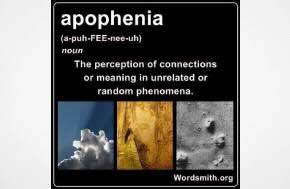
A passion for psychedelics may interact with a human cognitive bias known as apophenia, which is the tendency to perceive meaningful patterns where none exist, where you make connections between unrelated phenomena. Psychedelics may also enhance this apophenic tendency – both during and after the experience – which could help explain why some psychonauts become fixated on theories of how psychedelics played a crucial role in some aspect of humanity.
Of course, there are both plausible and evidence-based theories of how psychedelics influenced humanity, but these can be separated from the tendency to see this influence, in which enthusiasm can lead to belief in fringe psychedelic theories, irrespective of evidence. This doesn’t mean we should be dismissive of the tendency or theorising involved, as this openness and intellectual curiosity may lead to hypotheses that eventually are supported by evidence. On the other hand, we have good reason to be sceptical of viewing psychedelics as the ‘magic ingredient’ that made us human, when there may be less exciting (but more defensible) explanations at hand.
In this piece, I’ll be using the term ‘psychedelic apophenia’ to refer specifically to the tendency noted above, that is, apophenia about psychedelics, or forming patterns out of unrelated things so that we see psychedelics’ role in ‘X’. However, as we’ll see later on in the article, apophenia caused by psychedelics may be a contributing factor in this tendency.
How Psychedelic Apophenia Manifests
In my early 20s, I did a solo trip across southern and central Mexico. I visited many Maya and Aztec ruins. This was also early in my days of being interested in psychedelics, and I was aware of the influence that psilocybin mushrooms had in ancient Mesoamerica. My trip ended in Mexico City, where I visited the National Museum of Anthropology, the largest and most visited museum in Mexico, which contains significant archaeological and anthropological artefacts from the country’s pre-Columbian heritage, such as the Stone of the Sun (or the Aztec calendar stone).
One artefact, an Aztec statue of the god Xōchipilli, includes carvings of what scholars believe to be various psychoactive plants and fungi, although there is no consensus about what plants and fungi are depicted: candidates include psilocybin mushrooms (Psilocybe aztecorum), tobacco (Nicotiana tabacum), ololiúqui (Turbina corymbosa), sinicuichi (Heimia salicifolia), and cacahuaxochitl (Quararibea funebris). We know the Aztecs ceremonially used these natural psychoactives. In addition, as the scholar Osiris González Romero writes:
The expression of astonishment by the statue is palpable, intensified by the position of its face thrown back and the depth of its gaze. Viewing the statue, we are in the presence of someone who is not looking as we do everyday, who is absorbed in rapturous experience, the sacred trance of the temicxoch, what they [the Aztecs] call “The Flowery Dream.”
Read the full article at
Psychedelic Apophenia: Seeing the Influence of Psychedelics Where None Exists