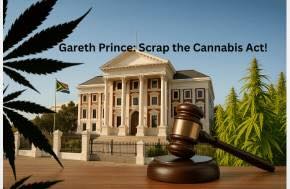
Veteran activist Gareth Prince has rejected the overtures of senior DTIC cannabis advisor John Jeffery to rethink next week’s court action that could jeopardize the Cannabis Act. Prince says he is pushing ahead with his challenge as the Act was a ‘slap in the face for the dagga community’. In a hard hitting letter to Cannabiz Africa, the chair of the SA Cannabis Develoment Council, says the Act is an absurdity, the public consultation excercise was a sham and that his participation on the Cannabis Plan steering Committee has been a ‘waste of time’.
Dear Editor.
The Project Manager for the National Cannabis Masterplan issued a plea to myself and the dagga community during the Cheeba Cannabis and Hemp Summit on 29 May 2026, to reconsider our challenge to the constitutionality of the Cannabis for Private Purposes Bill which was signed into law as Act 7 of 2024, (CPPA) The act is yet to come into operation.
He remarked that a successful challenge to the Act would setback the legislative efforts made thus far and hamper progress in the cannabis industry. Both these sentiments must be confounded and rejected. We are going back to court because the executive and the legislature have failed to provide us with effective and meaningful relief, for us to enjoy our rights.
The dagga community have been waiting for more then 8 years for justice and we are prepared to wait a bit longer; because the CPPA does not deliver the justice our community deserves, and is quite frankly, a slap in the face of our community.
Despite having participated diligently in the legislative process, our participation was never adequate neither was consultation meaningful.
“Government took decisions on their own and then reported those decisions to us. That is dictation, not consultation. We should have been part of the conceptualisation and development of the new laws from the outset if government was genuine in making a just dagga law.
Government’s narrow views on the new dagga laws and their lack of understanding of their constitutional obligations flows from a failure to embrace the culture and history of dagga as well as a failure to embrace the new philosophy in Chapter 3 of our constitution, which requires contextualised, interconnected and interdependent legislation and policies. There is a further duty on the government to reasonably accommodate the dagga community yet there has been no accommodation only continued persecution.
The idea that dagga can only be removed from the drugs act once the CPPA comes into operation is simply wrong. Nothing prevented the Dept of justice from removing dagga from the ambit of the drugs act on 19 September 2018. Equality, reason and logic demanded that dagga be regulated like alcohol and tobacco, neither of which appear in the schedules to the drugs act.
The Department of Justice should never have drafted the new cannabis law, and the new law was never meant to only cover privacy as this contradicts the dictates of the chapter on co-operative governance, and our constitutional jurisprudence. Alcohol is regulated by DTIC and Cannabis should also be regulated by them as is the plan with new all inclusive bill
Human rights must be interpreted from a holistic and integrated perspective as opposed to a disjointed and disparate perspective. The CPPA is anything but holistic and integrated, and simply perpetuate racial and systemic inequality.
In a country that allows people to smoke themselves into cancer and drink themselves into cirrhosis, we are told that we must be protected from cancer-curing cannabis and a healthier alternative to alcohol. The prejudice is staggering especially in a country where dagga is indigenous and in the hands of indigenous people. It would seem only white people can benefit from the death and pain of others. Despite the fact that 100 000 people die yearly from alcohol and tobacco usage, nobody is talking about criminalising it, because the means of production is owned by white people.
The CPPA is deeply flawed on procedural and substantive grounds. It does not serve the interests of the dagga community, but demands to be served. It doesn’t have anything positive to say about dagga or our community and it in fact perpetuates the racist mentality of seeing us through the lens of criminality, as opposed to culture. Instead of empowering us to enjoy our rights it has found new pathways to downpress us, like using our children to further restrict our rights.
The CPPA provides no legal source of cannabis and specifically prohibits dealing. A legislative regime that purports to guarantee rights to use, possess and cultivate dagga, and which absolutely prohibits dealing and which make no provision for a legal source of dagga, leads to what Canadian Appellate courts called, ” a legal absurdity”. This contradiction has been observed by many in the industry and shared with the legislator, right from the start of the legislative process, but it was ignored in the final product.
Whereas the legislature were directed by the apex court to develop a regulatory framework to accommodate use, possession and cultivation of dagga, they neglected to do so and instead developed frameworks for hemp and medical cannabis whilst ignoring dagga. The pace of cannabis legislation makes a mockery of Sec 237 of the constitution which direct that all constitutional obligations must be performed diligently and without delay.
Clearly what the current state of affairs demonstrate is that the government is not prepared to comply with the negative duty of respecting our rights, let alone the positive duties. The negative duty to respect dagga requires of the state not to put obstacles in the way of enjoying the right, and to refrain from inhibiting the ability to exercise the right.
The failure to develop commercial pathways is inexcusable. The President have talked about empowering small scale farmers but he is not practising what he is preaching. His government wants small farmers to abandon their landrace strains to work with foreign hemp strains. This is unsustainable.
Dagga can do what hemp does, but hemp cannot do what dagga does. It is reckless and reminiscent of Apartheid for the government to choose foreign hemp strains over their own landrace strains without having conducted any environmental impact assessments or knowing what their own indigenous plant can do.
We championed a program under the IKS Cannabis Sandbox which is focused on using landrace dagga varieties for biodiesel but which suggested a zero waste program. After collecting the seeds the rest of the plant could comfortably fit into the 9 pillars of the National Cannabis Masterplan.
We received written approval for this program in unambiguous terms from the lead department for the National Cannabis Masterplan, yet when time came for government to fulfill the terms of their approval, they reneged on their promises. The DTIC, failed to do what a lead department should do and neglected to co-ordinate their policies with that of Agriculture and DFFE ministries in violation of Sec 41(1)(h)(iv) of the Constitution.
The public participation process was a complete and utter sham, a tick box exercise. Parliament did not adhere to its own public participation framework of adequate public participation or meaningful public consultation.
This Bill had no white paper or green paper. There was no Socio-economic Impact Assessment Strategy (SEIAS) No physical public hearings, no advertising or public workshops. Parliament’s engagement with the dagga community was confined to online hearings. They published the Bill only in English and all meetings were conducted in English.
Not once during the whole process did our community feel respected or that our views were seriously considered. None of our views made it into the final bill. Parts of the bill on which we made comments, were unilaterally removed without informing the community.
Sitting on the Presidential Cannabis and Hemp Steering Committee has been a colossal waste of time and energy. Government partners dictated as opposed to consulted. IKS partners voice was muffled and Rastafari was the only voice that pushed back and agitated for the adoption of the IKS Cannabis Sandbox.
Project Vulundlela whose mandate is to clear up bottlenecks did nothing in relation to dagga. It is this failure to protect and enable us to legally exercise our 1st , 2nd and 3rd generation rights , that have us back before court. We are obliged to approach the court because the executive and the legislature failed to provide us with effective relief.
Despite having been failed by the apex court, the executive, the legislature and Chapter 9 institutions, the dagga community is still acting in a constitutionally compliant manner and we respect the rule of law by not taking the law into our own hands, because we are confident that reason will triumph over force.
Gareth Prince
Read full story
https://www.cannabiz-africa.com/blog/6a1fda149c569ef15610bac0
and
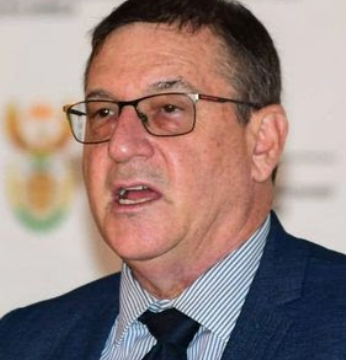
The DTIC’s senior cannabis advisor has warned that the Government’s attempts to regulate the cannabis industry could suffer a severe setback from Gareth Prince’s court challenge. John Jeffery (pictured above) publicly urged Prince to talk to him ahead of next week’s court hearing: “Ras Prince, I hope that there is an opportunity to discuss this ahead of the court case” said Jeffery, who supported the first part of Prince’s urgent application to halt cannabis arrests, but said “if the second part of the application goes through, well, it’s back to the drawing board for cannabis in this country”.