Rothwell, Figg, Ernst & Manbeck, P.C.
Introduction
Psychedelic drug development is moving from a largely experimental field toward a suddenly much more compelling pharmaceutical industry, with a rapidly expanding clinical pipeline that now includes multiple late-stage candidates across depressive, anxiety, trauma-related, and substance use disorders. While in August 2024, the FDA declined approval of Lykos Therapeutics’ MDMA-assisted therapy for post-traumatic stress disorder based on concerns around selection bias and functional unblinding in its clinical trial, recent FDA guidance provides sponsors with a more defined framework for addressing the distinctive trial-design, safety, and regulatory issues presented by these products. And a series of high-value acquisitions and licensing transactions demonstrates growing commercial interest in the intellectual property underlying psychedelic and psychedelic-adjacent therapies that include non-hallucinogenic molecules. With big pharma resources now powering these drug candidates and real FDA guidance aimed at speeding approvals, the next phase of the field is primed to move rapidly from clinic to market. On that path, regulatory strategies, patent protection landscapes, licensing, and strategic acquisitions will separate the winners from the losers.
FDA Guidance
The U.S. Food and Drug Administration (FDA) has finalized its long-awaited guidance, Psychedelic Drugs: Considerations for Clinical Investigations, providing sponsors with the Agency’s current framework for developing psychedelic therapies intended to treat psychiatric disorders, substance use disorders, and other medical conditions1. The final guidance formalizes the FDA’s first draft guidance on the subject, issued in June 2023, after public comment and further agency consideration2. Consistent with the draft, the 2026 guidance emphasizes that psychedelic drug development remains subject to the same statutory standards governing safety and effectiveness as any other investigational drug program, while recognizing that these products present unique scientific and regulatory challenges stemming from their psychoactive effects, the possibility of durable clinical benefit after limited administrations, and the frequent incorporation of psychotherapy or other behavioral interventions into treatment protocols. Rather than prescribing specific trial designs, the FDA provides a series of foundational principles to assist sponsors in designing development programs capable of generating reliable evidence of both efficacy and safety.
One focus of the guidance is on mitigating bias and improving the interpretability of clinical trial results. Because psychedelic drugs often produce perceptual disturbances that may reveal treatment assignment, the FDA identifies functional unblinding as a central methodological concern and recommends that sponsors consider alternative control arms, including lower doses of the investigational psychedelic or other psychoactive comparators, together with blinded central raters, blinding questionnaires for subjects and investigators, and expectancy assessments administered both before randomization and after treatment. The guidance further recommends that studies intended to support approval for chronic conditions, such as major depressive disorder or post-traumatic stress disorder, evaluate efficacy through at least 12 weeks under double-blind conditions, continue blinded follow-up for approximately 12 months with prespecified retreatment criteria, characterize dose-response relationships early in development, and, where appropriate, pair complementary Phase 2 and Phase 3 study designs to address both dose-response and safety questions. The FDA also recommends stratifying randomization based on prior psychedelic use to minimize expectation bias, encouraging representative study populations, and considering factorial trial designs to distinguish the therapeutic contribution of psychotherapy from that of the investigational drug. Sponsors are further encouraged to describe how psychotherapy will be incorporated into the treatment paradigm and how potential bias associated with therapist awareness of treatment assignment will be mitigated.
Safety remains paramount for psychedelic trials; beyond trial design, the guidance establishes detailed recommendations for both safety monitoring and broader development strategy, including observation by both a licensed psychotherapy professional as the lead monitor and a qualified assistant monitor, with a physician available to reach the clinical site within 15 minutes if the lead monitor is not a physician. The FDA also recommends informed consent documents specifically address the prolonged alterations in perception, cognition, judgment, and suggestibility associated with psychedelic administration, and that expected psychoactive effects—including euphoria, hallucinations, perceptual distortions, cognitive changes, and mood alterations—be systematically documented throughout treatment sessions, even where those effects are anticipated or not perceived by subjects as adverse. The guidance further discusses abuse potential assessments, explaining that traditional self-administration and conditioned place preference studies are generally unnecessary for psychedelic drugs, while recognizing that a dedicated human abuse potential study may not be scientifically necessary where extensive clinical and epidemiological evidence already characterizes abuse-related subjective effects. Additional recommendations address evaluation of potential 5-HT2B-mediated cardiac risks, driving impairment, literature-based identification of adverse events associated with recreational use, and the possible need for postmarketing risk mitigation measures, including Risk Evaluation and Mitigation Strategies (REMS) and additional postmarketing safety studies.
Exemplary Psychedelic Drugs in Development
The psychedelic drug development pipeline has expanded significantly over the past several years, with dozens of product candidates currently under investigation across multiple classes of psychedelic compounds and neuropsychiatric indications. Psilocybin and related compounds represent the most active area of development, although sponsors are also advancing programs involving MDMA and related compounds, LSD analogs, DMT and 5-MeO-DMT derivatives, ibogaine analogs, and ketamine-based therapies. Current development efforts are primarily focused on psychiatric disorders, including major depressive disorder (MDD), treatment-resistant depression (TRD), generalized and social anxiety disorders, post-traumatic stress disorder (PTSD), substance use disorders, and bipolar depression, with additional programs targeting conditions such as autism spectrum disorder, obsessive-compulsive disorder, postpartum depression, adjustment disorder, binge eating disorder, and chronic pain.
Among approved therapies, Janssen’s Spravato® (esketamine) remains the only FDA-approved product within the broader psychedelic and dissociative medicine landscape, having received approval for treatment-resistant depression and, subsequently, major depressive disorder with acute suicidal ideation or behavior. Beyond Spravato®, numerous sponsors have advanced psychedelic therapeutics into late-stage clinical development, including psilocybin-, ketamine-, DMT-, MDMA-, and LSD-based candidates targeting treatment-resistant depression, major depressive disorder, PTSD, anxiety disorders, substance use disorders, and other neuropsychiatric conditions. Representative programs are summarized below.
| Compound | Sponsor | Regulatory Status |
|---|---|---|
| Spravato® (esketamine) | Janssen | FDA Approved |
| COMP360 (psilocybin) | Compass Pathways | Phase 3 |
| Psilocybin | Usona Institute | Phase 3 |
| Intranasal mebufotenin benzoate (BPL-003) | Eli Lilly (via AtaiBeckley acquisition) | Phase 3 |
| LSD D-tartrate ODT (DT120) | Definium | Phase 3 |
| IV Ketamine (NRX-100) | NRx Pharmaceuticals | Phase 3 |
| Oral Ketamine (R-107) | Tasman Therapeutics | Phase 3 |
| Deuterated psilocin analog (HLP003) | Helus Pharma | Phase 3 |
| β-ketone analog of MDMA (TSND-201) | Otsuka (via Transcend Therapeutics acquisition) | Phase 3 |
| IV Ketamine (SVN-001) | Solvonis | Phase 3 (UK and EU only) |
| Luvesilocin (RE104) | Reunion Neuroscience | Phase 2 |
| Deuterated DMT (HLP004) | Helus Pharma | Phase 2 |
| R(+)-MDMA (DT402) | Definium | Phase 2 |
| Non-racemic MDMA (ALA-002) | Jupiter Neurosciences (via PharmAla) | Phase 2 |
| Psilocybin | Filament Health, Incannex, Diamond Tx, Apex Labs, GH Research | Phase 2 |
| IV Psilocin (ELE-101) | Amandala Neuropharma | Phase 2 |
| Buccal-film DMT (VLS-01) | Eli Lilly (via AtaiBeckley) | Phase 2 |
| Bretisilocin (GM-2505) | AbbVie | Phase 2 |
| 5-MeO-DMT (BMND005) | Bionomics/BioMind | Phase 1 |
| MSP-2020 | Otsuka (via Mindset Pharma acquisition) | Phase 1 (Europe) |
This expanding pipeline has coincided with increasing federal interest in psychedelic therapeutics, including President Trump’s April 2026 Executive Order encouraging additional research and directing expedited review of scheduling determinations for qualifying products that successfully complete Phase 3 clinical trials. While the long-term impact of these initiatives remains uncertain, the breadth of current clinical development suggests that psychedelic-based therapeutics are likely to remain an active area of pharmaceutical innovation and regulatory attention over the coming years.
IP and Licensing Landscape
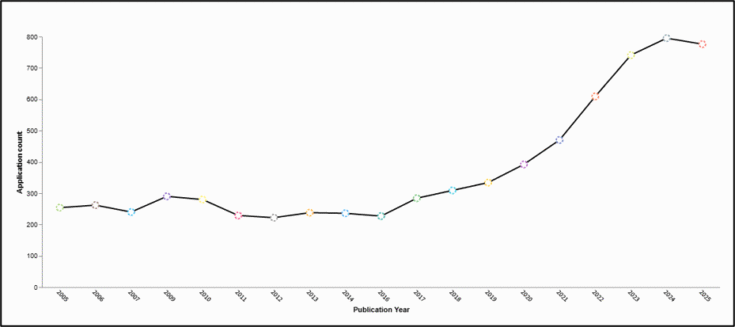
The maturation of the psychedelic therapeutics sector has been accompanied by a corresponding expansion of its intellectual property landscape. As shown in the figure below, the number of published patent applications directed to psychoactive drugs has increased steadily year over year, reflecting sustained investment in novel compounds, formulations, methods of treatment, and related technologies. This growth in patent activity has coincided with the progression of psychedelic drug candidates into later-stage clinical development and an increasing number of licensing transactions, acquisitions, and strategic collaborations involving clinical-stage assets and related intellectual property.
The increase in patent activity has been accompanied by increased licensing and acquisition activity. Several significant transactions announced or completed during the past year involve clinical-stage assets, platform intellectual property, or territorial commercialization rights. These transactions illustrate several emerging deal structures in the field, including outright acquisitions of individual drug candidates, acquisitions of clinical-stage companies, and territory-specific licenses that preserve the licensor’s rights outside the licensed market.
July 2026
On July 20, 2026, PharmaAla Biotech announced that it executed a definitive license agreement with Jupiter Neurosciences with exclusive U.S. rights to ALA-002. ALA-002 is PharmAla’s lead drug candidate and a patented, non-racemic MDMA formulation that is currently in U.S. clinical trials for individuals with PTSD and anxiety. The deal between PharmaAla Biotech and Jupiter includes an exclusive, perpetual license to develop, manufacture, and commercialize ALA-002 in the U.S. for an upfront payment of $3,333,333. It also includes the potential for up to $23,333,333 in development and regulatory milestones and up to $73,333,333 in commercialization milestones. PharmAla retained all rights to the candidate outside the United States.
On July 16, 2026, Eli Lilly announced that it is acquiring AtaiBeckley. 5-MeO-DMT, or BPL-003, is AtaiBeckley’s lead candidate and is entering Phase 3 clinical trials. Eli Lilly will acquire all outstanding shares of AtaiBeckley up to $3.8 billion to gain access to BPL-003 and a DMT-based candidate (VLS-01). BPL-003 is the lead asset among multiple clinical-stage programs and a discovery pipeline of next-generation compounds. With the acquisition of AtaiBeckley, “Lilly’s expertise and reach are expected to accelerate [demonstrating that psychiatric illness is treatable at its biological root] for people whose conditions have not responded to existing treatments.”3 The transaction represents one of the largest acquisitions in the psychedelic therapeutics sector to date and reflects growing confidence that next-generation neuropsychiatric therapies are approaching commercial maturity. By combining AtaiBeckley’s clinical-stage pipeline with Lilly’s global development, regulatory, manufacturing, and commercialization capabilities, the acquisition has the potential to advance the development and availability of novel treatments for patients with significant unmet medical needs.
June 2026
On June 12, 2026, Otsuka announced that it completed the acquisition of Transcend Therapeutics. Transcend was developing a methylone, or TSND-201, which is entering Phase 3 clinical trials as a PTSD candidate. The agreement resulted in a $700 million payment from Otsuka to Transcend shareholders at closing and the potential for $525 million in additional contingent considerations. In addition to the Phase 3 clinical trials for TSND-201 for PTSD, Transcend was also developing candidates for generalized anxiety disorder and major depressive disorder. Otsuka previously acquired psychedelic drug discovery company Mindset Pharma to gain control over MSP-2020 and other drug candidates.
May 2026
On May 13, 2026, PharmAla Biotech entered into an agreement with Aluvaris and Diteba to establish Restora Neurosciences, a jointly owned special-purpose vehicle formed to advance APA-01 through clinical and regulatory development. APA-01, or (R)-2-[(2H-1,3-benzodioxol-5-yl)methyl]pyrrolidine, is a novel molecule covered by U.S. Patent No. 12,042,478 and a related global patent estate. APA-01 is being developed for therapeutic applications in psychological trauma and neurological conditions, including Post-Stroke Neurorehabilitation and Traumatic Brain Injury (“TBI”). Restora’s initial objective is to complete the work required to submit a first investigational new drug application to the FDA.
The transaction is notable because PharmAla retained ownership of the underlying intellectual property while licensing development and commercialization rights to the jointly owned vehicle. PharmAla also retained an economic interest through its equity ownership, license fees, royalties, and participation in sublicensing revenue, while Aluvaris assumed responsibility for raising the capital required to fund Restora’s operations and Diteba provided development services.
October 2025
On October 17, 2025, AbbVie acquired Gilgamesh Pharmaceuticals’ lead candidate, bretisilocin, or GM-2505, for major depressive disorder at a value of $1.2 billion with $900 million paid up front.
June 2025
On June 3, 2025, Rose Hill Life Sciences announced an exclusive license from Johns Hopkins University covering intellectual property directed to the use of psychedelic therapy to improve motor function following neurological injury. The licensed technology includes psilocybin and methods for improving motor function in patients with acute, subacute, or chronic central nervous system injuries and for treating focal diaschisis associated with such injuries.
Conclusion
Success will nevertheless depend on more than showing a pharmacological effect. Sponsors will need to address functional unblinding, durability of response, repeat dosing, safety monitoring, abuse potential, and the role of accompanying psychotherapy, while also assembling IP portfolios and commercial arrangements capable of protecting substantial development investments. As additional candidates advance toward pivotal trials and potential approval, regulatory execution and IP strategy are therefore likely to become increasingly important differentiators among psychedelic drug-development programs.
- Psychedelic Drugs: Considerations for Clinical Investigations, Guidance for Industry. HHS. FDA. CDER. July 2026. Accessed July 15, 2026. https://www.fda.gov/media/169694/download. ↩︎
- Psychedelic Drugs: Considerations for Clinical Investigations. FDA. July 2026. Accessed July 15, 2026. https://www.fda.gov/regulatory-information/search-fda-guidance-documents/psychedelic-drugs-considerations-clinical-investigations. ↩︎
- Quoting AtaiBeckley’s co-founder and chief executive officer https://investor.lilly.com/news-releases/news-release-details/lilly-acquire-ataibeckley-advance-therapies-treatment-resistant ↩︎
[View source.]
Source JD Supra
https://www.jdsupra.com/legalnews/fda-guidance-clinical-pipelines-and-the-1219164/