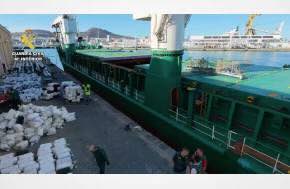
The record seizure of more than 30 tonnes of cocaine aboard the general cargo vessel Arconian has intensified concerns that organised crime groups are increasingly turning to general cargo ships to move narcotics into Europe.
A new report from the Global Initiative Against Transnational Organized Crime (GI-TOC) says the interception of the vessel by Spanish authorities in May offers a rare insight into an evolving trafficking model that uses general and heavy lift cargo vessels operating between West Africa and Europe to transport bulk cocaine shipments.
The Comoros-flagged Arconian departed Freetown, Sierra Leone, on April 22, and sailed continuously until it was intercepted off the Canary Islands. Investigators believe the cocaine was loaded in Sierra Leone and was intended to be transferred to smaller powerboats near the Canary Islands before onward distribution into European markets.

The seizure, which Spanish authorities said was the largest cocaine haul in the country’s history, was not an isolated case, says GI-TOC. Researchers say at least two other general cargo vessels, including the multipurpose & heavy lift carrier White Labeille, that have been displaying similar operating patterns, including voyages between Sierra Leone and North Africa, repeated loitering near the Canary Islands and Morocco, and frequent ownership and flag registration changes.
According to GI-TOC, mapping the historical management of the Arconian, White Eagle, and White Labeille reveals a highly consolidated network with deep nodes in Germany and Türkiye. Prior to being acquired by Sierra Leonean front companies with no prior commercial history, all three vessels were sold by separate German-registered corporate entities (Firat Shipping, Toprak Shipping, and Zeynep Shipping). Crucially, these three previous owners – alongside Tunaryan Schifffahrts GmbH, the German company that managed all three vessels – share the exact same registered corporate address in Flensburg, Germany.
Logistical footprints
The report further notes that in late 2022, a Turkish ship management company based in Gaziantep, Nisa Uluslararasi Deniz, took over as the international safety manager for all three ships, placing them under an identical dual German-Turkish management structure. Researchers say neither company is a major maritime operator. While these highly repetitive corporate patterns do not automatically establish legal culpability, they mirror the personal and logistical footprints of suspected trafficking network leaders who were heavily established in both Türkiye and Sierra Leone during the same period.
The report suggests that cargo vessels are increasingly being used to move large consignments from storage hubs in West Africa to drop-off points close to Europe, allowing traffickers to bypass the intense scrutiny faced at major container ports.
GI-TOC said the movement of cocaine aboard cargo vessels may help explain how large quantities of the drug have continued to reach European markets despite enhanced enforcement efforts at major gateways. The organisation argues that the Arconian case points to a broader trafficking ecosystem in which conventional cargo ships serve as “mother vessels”, carrying bulk consignments before transferring them offshore to smaller craft.

Unlike the Arconian, GI-TOC says that while cocaine has not been seized on either the White Labeille or White Eagle, another general cargo vessel, photographs and witness testimonies ‘point to connections’ with trafficking activities linked to an established smuggling network.
Researchers also say that vessels employed in trafficking are used more than once and ‘only abandoned if suspicions are aroused’, which ‘appears to have been the case for the White Eagle, and possibly also for the White Labeille’.
“Links between the three vessels are further supported by (analysis) of their recurring patterns of ownership, management, flagging, voyaging and vessel characteristics,” it adds.
‘Recurring patterns’
The ‘behaviour’ of six other general cargo or dry bulk ships, whose ownership, flagging or voyage patterns show clear links to these three, says GI-TOC.
The report also highlights characteristics that will be familiar to maritime compliance specialists, including the use of flags of convenience, rapid reflagging, ageing vessels and opaque ownership structures. Researchers noted similarities between some of the vessel behaviours observed and those commonly associated with sanctions-evasion ‘shadow fleets’.
Read More