Lots of detail as reported by the Nebraska Examiner
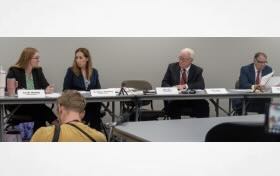
LINCOLN — The Nebraska Medical Cannabis Commission on Thursday approved emergency regulations to begin accepting medical cannabis applications as soon as Gov. Jim Pillen gives his final green light.
State law requires him to do so by Tuesday.
The emergency regulations, unveiled for the first time minutes before the 10 a.m. meeting, largely mirror a legislative proposal that lawmakers stalled on last month. The regulations would take effect for up to 90 days, pending Pillen’s approval. The two medical cannabis-related laws that voters approved mandate that applications must start being accepted no later than July 1.
Commissioner Lorelle Mueting of Gretna, an addiction prevention specialist through Heartland Family Service, affirmed that commissioners want public feedback on the emergency regulations through July 15, to inform future, formal regulations.
Public comments may be submitted to lcc.frontdesk@nebraska.gov, the repository for the Nebraska Liquor Control Commission, which will forward the messages onto the state’s new Medical Cannabis Commission.
“The input that the public provides on these emergency regulations will help us immediately begin drafting the regular regulations,” Mueting said Thursday.
Emergency regulations process
Dr. Monica Oldenburg, an anesthesiologist who chairs the commission, will send a letter to Pillen relaying the emergency regulations and stating that the “failure” to adopt them by the deadline “would force Nebraskans to seek medical cannabis or similar products from unregulated and potentially harmful sources.”
A spokesperson for Pillen said Friday that the governor “is carefully reviewing the emergency regulations and will have a decision by July 1.”
Licensing of new establishments must begin by Oct. 1, according to the laws. The emergency regulations would allow licenses for, at minimum, cultivators, product manufacturers, dispensaries and transporters, and someone could be awarded only one type of license.
Justification for emergency regulations under state law can include “imminent peril” to public health, safety or welfare.
Mueting and Oldenburg will head up a subcommittee to work on the regulations in the meantime.
Commissioners also voted 4-0 to enter a legal partnership with the Nebraska Department of Health and Human Services and Pillen’s Policy Research Office, which allows the commission to contract with DHHS for “legal services.”
Dispensary restrictions
Legislative Bill 677, which fell 10 votes short of the 33 votes needed to change a voter-approved law last month, 23-22, would have provided additional guardrails around the ballot measures that voters overwhelmingly approved in November. Up to 30 dispensaries would have been allowed under that bill, up to 10 in each congressional district.
Under the emergency regulations, no more than one dispensary would be allowed in each of the state’s 12 District Court Judicial Districts. Douglas County (Omaha) and Lancaster County (Lincoln) are the only counties that occupy a single district. Multiple medical cannabis advocates asked the commission to reconsider that specific restriction.
No dispensary could located within 1,000 feet of any school, daycare, church or hospital. At least 51% of an applicant’s business or organization would need to have resided in Nebraska and be a U.S. citizen for at least the past four years. Applicants also would need to pay to submit two legible sets of fingerprints to the FBI and the Nebraska State Patrol for a criminal background check.
Qualifying conditions and allowable products
Unlike LB 677, the emergency regulations do not specify qualifying medical conditions. LB 677 would have outlined 15 conditions eligible for the medicine. That list excluded post-traumatic stress disorder.
Nebraskans in November overwhelmingly legalized up to 5 ounces with the recommendation of a health care practitioner.
The emergency regulations would require that a recommendation (from any provider nationwide) specify the product being recommended, the recommended dosage and potency, the number of doses, the directions for use and the name of the patient.
The regulations would allow dispensaries to sell:
- Oral tablets, capsules or tinctures.
- Non-sugarcoated gelatinous cubes, gelatinous rectangular cuboids or lozenges in a cube or rectangular cuboid shape.
- Gels, oils, creams or other topical preparations
- Suppositories.
- Transdermal patches.
- Liquids or oils for administration using a nebulizer or inhaler.
Dispensaries could not sell raw plant or flower, food or drinks with cannabis infused into it (edibles), any products containing artificial or natural flavoring or coloring and any products administered by smoking, combustion or vaping.
LB 677 would have mandated testing of all products before they could be sold, one of the strictest testing regimes in the country. However, without a legislative change, the commission lacks the explicit authority to regulate testing under the medical cannabis laws. Instead, the emergency regulations say products “may” be submitted for testing or research for development purposes.
Packaging would need to be able to show it had been tampered with, child-resistant, resealable and protected from contamination.
Similar to 2024 restrictions on vaping products, cannabis products could not depict cartoon-like fictional characters or mimic characters primarily aimed at entertaining minors, trademarks or trade dress or products that imitate or mimic products primarily marketed to minors, symbols primarily used to market products to minors or the images and likenesses of celebrities.
Shari Lawlor of Valley told the commission that her 32-year-old daughter, Brooke, has faced severe seizures for the past 31 years but “nothing in modern medicine has helped her,” including brain surgery in 2024.
Shari Lawlor said her daughter has 11 bottles of medications and takes “handfuls” of pills.
“They’re going to kill her. If it’s not one organ, it’s another,” Lawlor said. “I would just like the option to have complete access for the patients, and that’s only by letting all different products on the market.”
Pharmacist concerns
Jim Wilson, a clinical pharmacist speaking on behalf of the Nebraska Pharmacists Association, said he has seen positives and negatives of cannabis. He asked the commission to seek input from pharmacists because of possible side effects with other drug interactions.
Wilson advocated for adding medical cannabis to the state’s prescription drug monitoring program used for other medications, which LB 677 would have done, too.
“We are not interested in the politics or any particular party or any of that,” Wilson told the commission. “We’re interested in the patient and what might happen to them.”
State Sen. Ben Hansen of Blair, who introduced LB 677, said Friday that many of the guidelines looked “copied” from his bill. The final regulations are where people who care about the issue will want to see proof “in the pudding,” he said.
“Life would have been much easier if [lawmakers] would have just passed LB 677,” Hansen said, adding that he hears from people who have “some hesitancy about where they’re going with this,” and called that feeling “totally justified.”
Hansen also repeated his previous concerns about the Nebraska Attorney General’s Office having said it would sue the commission as soon as it issues licenses. He questioned how much those lawsuits and others might cost taxpayers.
State Sen. John Cavanaugh of Omaha, who helped advocate for LB 677, said the commission has no legal authority to restrict the forms of cannabis available to patients.
“To disallow by regulation what is clearly allowed by statute is a slap in the face to the patients and families who need this medicine and the voters of Nebraska who approved it by an overwhelming majority,” he said in a text.
and yes there’s more
Nebraska commission approves emergency medical cannabis regulations