Straits Times
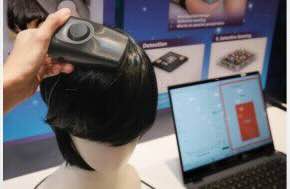
SINGAPORE – Just clip the device onto a person’s hair, scan and, in under a minute, it would be able to tell if the individual is positive for drugs.
The result from the hair scanner is displayed on a laptop.
About the size of a laptop mouse, it does not require hair to be cut.
The scanner is one of the future technologies being assessed by the Central Narcotics Bureau (CNB), and was featured at the CNB Workplan Seminar 2026 at the Singapore Expo on July 22.
The non-invasive device, currently being developed in-house by the Home Team Science and Technology Agency (HTX), aims to improve CNB’s operational efficiency by simplifying and shortening the drug screening process.
Senior forensic scientist Ong Sheau Wei from HTX’s Forensics Centre of Expertise said the hair scanner uses spectroscopy, which records the wavelengths of light absorbed or emitted by hair.
She said Singapore is probably the only country exploring the use of such a device to detect drug use.
Another game changer that will make the job of a CNB investigator more efficient is NarcoNet, an AI-enabled platform that greatly reduces manual-entry investigative work.
The software can look at a suspect’s mobile phone and chat logs to discover incriminating discussions, photos or drug deals in any language.
Developed jointly by CNB and HTX, NarcoNet can take all the information gathered in a drug investigation and produce a statement of facts (SOF).
An investigator, who would normally take hours to prepare an SOF, will now be able to instantaneously generate an SOF via NarcoNet, which is targeted to be deployed by end-July.
Likewise, the Next Generation Reporting Centre was rolled out on July 1 at CNB Enforcement “E” Division. It automates the urine handling process, reducing the officers’ direct contact with samples and improves overall operational efficiency and hygiene.