
Thailand Tightens Cannabis Licensing Rules Through Two New Ministerial Regulations
Jul 13, 2026
In April 2026, the Ministry of Public Health issued two Ministerial Regulations that materially affect operators dealing with cannabis and hemp extracts and cannabis flowers. The first applies to cannabis and hemp extracts containing more than 0.2% tetrahydrocannabinol (THC), which remain Category 5 narcotics. The second applies to cannabis flowers, which continue to be regulated as controlled herbs under the Protection and Promotion of Thai Traditional Medicine Knowledge Act B.E. 2542 (1999).
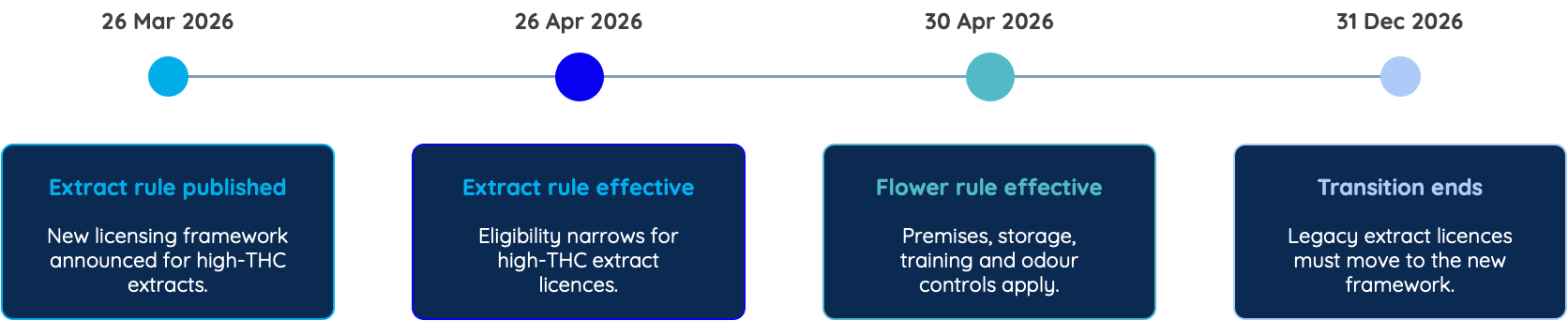
Figure 1. Regulatory Timeline.
The Ministerial Regulation on Licensing for the Production, Importation, Exportation, Sale or Possession of Category 5 Narcotics Specifically Cannabis or Hemp Extracts B.E. 2569 (2026) was published in the Royal Gazette on 26 March 2026 and took effect on 26 April 2026. It confirms that cannabis and hemp extracts exceeding the 0.2% THC threshold may be produced, imported, exported, sold or possessed only for specified purposes: government narcotics-control functions, medical use, medical or scientific research, and industrial use.
A key change is the narrowing of eligible licensees. Licenses for high-THC cannabis or hemp extracts may be granted only to Thai juristic persons that are not considered “foreign” under the Foreign Business Act B.E. 2542 (1999), government agencies, and the Thai Red Cross Society. This effectively removes foreign-owned businesses from the licensing pathway for activities involving high-THC cannabis or hemp extracts. Existing licenses issued under the 2020 and 2021 regulations remain valid only until 31 December 2026, after which operators must comply with the new licensing framework.
The second regulation, the Ministerial Regulation on Licensing for Research, Export, Commercial Distribution or Processing of Controlled Herbs (No. 2) B.E. 2569 (2026), was published in the Royal Gazette and took effect on 30 April 2026. It amends the existing controlled-herb licensing framework for cannabis flowers by imposing additional approval criteria and ongoing operating obligations.
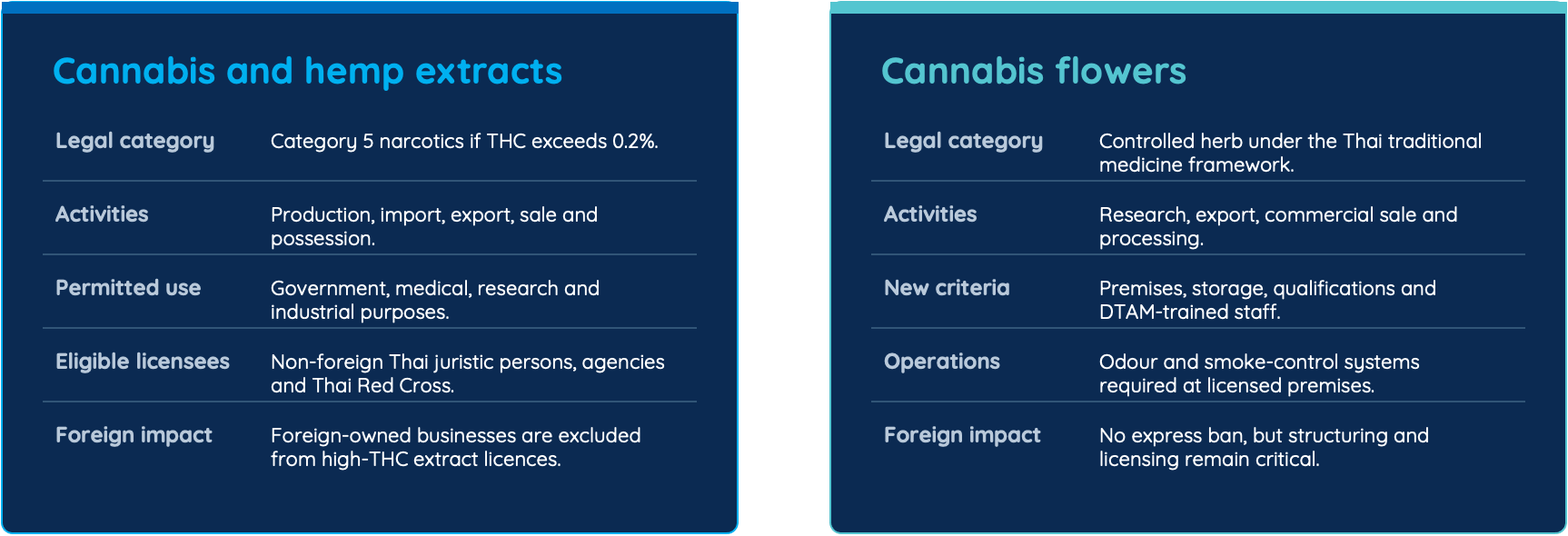
Figure 2. Two-Regulation Comparison.
Applicants for licenses involving the export, commercial sale or processing of cannabis flowers must now satisfy more rigorous conditions. They must demonstrate lawful ownership or possession of the licensed premises, maintain dedicated storage facilities capable of preserving cannabis-flower quality, hold or employ persons with prescribed medical, pharmaceutical, herbal, cultivation or traditional-medicine qualifications, and ensure that at least one employee who has completed the Department of Thai Traditional and Alternative Medicine (DTAM) cannabis training program is present during operating hours.
The amendments also increase post-licensing compliance obligations. Licensed premises must maintain an effective system for eliminating cannabis odor and smoke. Renewal is also more demanding: existing licensees must satisfy the general licensing conditions as well as the new cannabis-flower-specific criteria. A prior license suspension for breach of Ministry of Public Health notifications may also affect renewal prospects.
For existing operators, the practical impact is immediate. Pending applications may require supplementary documents, and current licensees should prepare for the new criteria before renewal. Operators should review title or lease documents for licensed premises, storage arrangements, staff qualifications, DTAM training records, odor and smoke-control systems, and compliance history. Businesses should also correct any regulatory gaps promptly, because past suspensions or unresolved compliance issues may now carry heavier consequences.

Figure 3. Compliance Checklist.
Foreign investors face different outcomes depending on the product category. For high-THC cannabis and hemp extracts, the new licensing rules expressly restrict eligibility to non-foreign Thai juristic persons, government agencies and the Thai Red Cross Society. For cannabis flowers, the regulation does not appear to impose the same express foreign-ownership prohibition, but foreign investors must still consider the Foreign Business Act, sector-specific restrictions, licensing conditions, and the practical need to satisfy local premises, personnel, training and compliance requirements.
Taken together, the two regulations show Thailand’s current policy direction: cannabis remains outside the narcotics list in certain forms, but commercial participation is being narrowed and professionalized. The emphasis is now on medical use, research, industrial use, qualified operators, traceable premises and stronger local regulatory control. Cannabis businesses should treat licensing as an ongoing compliance framework, not a one-time approval.
Recommended immediate actions: operators should map all cannabis-related activities by product type, THC level and business function; confirm whether high-THC extract activities remain legally viable under the new eligibility rules; prepare renewal documentation well before license expiry; ensure flower-related premises meet storage, staffing, training and odor-control requirements; and review foreign ownership structures before applying for or renewing licenses.

Figure 4. Recommended Review Process.