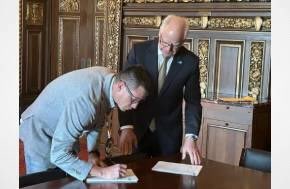
Minnesota Gov. Tim Walz signed two more cannabis compacts with tribal nations this week, bringing the total number of tribal‑state cannabis compacts to nine.
The Shakopee Mdewakanton Sioux Community and Lower Sioux Indian Community signed the agreements, expanding market opportunities outside tribal lands.
Joseph O’Brien, president of the Lower Sioux Indian Community tribal council, said the compact is a meaningful step forward for the tribe.
“This compact reflects the state of Minnesota’s growing respect for Tribal sovereignty and economic self-determination,” O’Brien said in a news release. “And we are excited for the opportunities it creates for our community — opportunities to support our people, strengthen our economy, and move forward in partnership with the state of Minnesota in a good way.”
The agreement recognizes the tribe’s authority to regulate cannabis business, including cultivation and sales activities, outside the tribe’s land in southern Minnesota.
“The state and Tribal leaders share a commitment to further build a mature cannabis industry that is safe, equitable and sustainable,” Eric Taubel, executive director of the state’s Office of Cannabis Management, said in a news release.
Taubel told MPR News that tribal partnerships support steady industry growth. In early stages of the market, “oftentimes you see kind of like a boom-and-bust cycle where there’s really, really short supply, early price spikes, and then there’s an oversupply — the price drops.”
“One of the ways that we see balancing that need for supply and demand, licensing and capacity is with these tribal partnerships,” Taubel said.
The scope of the state’s cannabis compact with the Shakopee Mdewakanton Sioux Community is narrower, with a focus on purchasing cannabis from producers around the state to supply its own dispensary on tribal lands.
“It’s really about how they can acquire cannabis grown by state license holders, as opposed to some of the other compacts that focus heavily on activity occurring off reservation, whether it’s a retail store or potentially a cultivation and manufacturing facility,” Taubel said.
The Shakopee Mdewakanton Sioux Community announced in late February that it plans to open a cannabis dispensary, Flame & Flora, this spring on tribal land in Prior Lake. The announcement said the dispensary plans to emphasize products grown and produced by other tribes and small-scale growers across the state, and other local manufacturers.
“The SMSC looks forward to opening its cannabis dispensary Flame & Flora in early April,” said Cole Miller, chairman of the tribe, in a statement to MPR News. “This compact reflects our tribal sovereignty and government-to-government relationship with the State of Minnesota. We are committed to operating Flame & Flora with a focus on public health, safety and education.”
Both compacts recognize tribal sovereignty and immunity, and affirm that cannabis activity on tribal land remains outside state jurisdiction.
Read more
https://www.mprnews.org/story/2026/03/11/two-dakota-nations-sign-cannabis-compacts-with-state