Let’s just give you some simple stats on Luxembourg for context
Wikipedia
|
Population – January 2025 estimate
|
 681,973 681,973 |
|---|
|
GDP Per capita
|
 $154,914 $154,914 |
|---|
Size – Approx 998 Sq Miles
“We stoners still have to hide,” said Tamai, noting that anyone caught with cannabis in public is still liable to prosecution. Personal possession of 5-10 grams should be permitted, he said. Carrying 3 grams or less is currently fined with €145, and larger quantities are punishable with prison.
Sharing a joint is also a criminal offence, and smoking is only permitted within your own four walls.
Luxembourg Times
Cannabis users in Luxembourg are still turning to the black market, the operators of a cannabis shop in the capital have said, despite the country’s decision to decriminalise use of the drug in certain circumstances two years ago.
Cannabis has been legal to take and cultivate under certain circumstances since summer 2023, with the growing of up to four cannabis plants per household from seeds for personal consumption permitted. However, the selling of cannabis and public consumption remain illegal.
The change in the law has shifted attitudes but has not moved users fully away from the black market, said the operators of Cannathèque, a specialised shop in the Gare district of Luxembourg City.
Cannabis remains Luxembourg’s drug of choice, according to the latest national drug report, with one in two adults having already used cannabis at least once in their lives.
The 2025 report showed that 14.6% of Luxembourg adults had consumed cannabis in the last 12 months, and that 11.5% of them had taken advantage of the right to grow cannabis legally at home.
Nearly a third of Luxembourg’s 15 to 34-year-olds reported having tried cannabis at least once in their life, with more men than women having tried it.
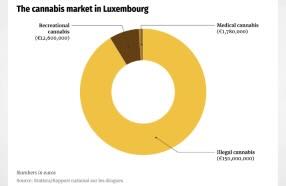
One gram of weed costs around €10 on the black market. Conservative estimates suppose that black market dealers in Luxembourg achieve an annual turnover of around €150 million.
When we look at what’s going on in the world today, cannabis is the least of our problems
However, a rethink has taken place in the minds of Luxembourgers since the change in the law, said Christophe Tamai, who has been the owner of Cannathèque for seven years.
“The public perception of cannabis has changed dramatically since partial legalisation,” he said, adding that he believes the drug is now less demonised. “When we look at what’s going on in the world today, cannabis is the least of our problems.”
CBD shops running into difficulties
“CBD took off in 2018,” said Tamai, referring to when the legal, intoxication-free cannabis variant came to Luxembourg.
At the time, specialised CBD shops were popping up all over the country. Tamai estimates that there were originally 40 to 50 sales outlets, of which only five to ten have survived.
Placebo, Luxembourg’s oldest cannabis speciality shop, filed for bankruptcy at the end of last year, 25 years after it was founded.
As CBD is smoked like tobacco, it has been taxed like tobacco since 1 January 2020. In addition to VAT of 17%, there is also a 33.75% tobacco tax. This has made CBD cannabis cheaper in neighbouring countries or online.
In France, for example, CBD flowers are considered a dietary supplement, so no tobacco tax is due. “In Luxembourg, almost nothing remains of the sales price,” said Tamai.
If you want to survive in the legal cannabis business, you have to diversify, the entrepreneur said. Hemp is a very diverse plant that can be used to produce more than just the drug.
Cannathèque started out as a CBD shop, but has since added other items for sale such as smoking accessories, yoga articles, teas, creams and other wellness products. “People are living more [health] consciously today,” said Tamai.
“Many use CBD to be more balanced,” he explained, adding that people often don’t want the “high”, but are instead looking for the therapeutic effect of CBD, which can help with stress, pain, inflammation or tension. “Before people go to the doctor and get a prescription for pills, they first look at what nature has to offer.”
Two months before partial legalisation, the Cannathèque stocked up on growing equipment. Anyone who wants to grow cannabis plants at home must first invest in the proper tools.
“Start-up equipment costs between €400 and €1,500,” explained Tamai. This includes plant tents, air filters, plant lights and cultivation kits, with the seeds the cheapest part. “There were also grow shops before legalisation, but they were in a legal grey area.”
Tomatoes can also be grown in a tent designed for cultivating cannabis. However, Tamai said he “didn’t want to talk to the customers about tomatoes”, and instead waited until after the new legislation had passed.
When the big day arrived however, not much happened. Customers didn’t queue up to stock up on growing equipment and cannabis seeds. “Decriminalisation had little direct impact on business,” said Tamai, recalling the reluctance of customers.
More at