Unfortunate name considering what he wants . There was another Eric with a c Harris back in 1999.
Marijuana Moment
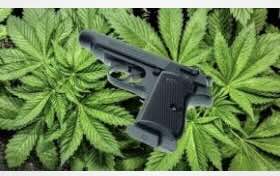
A man who was prosecuted after admitting to lying about his marijuana use on a federal firearms purchasing form is now asking the U.S. Supreme Court to take up the matter as the justices are set to discuss several other cases on cannabis consumers’ gun rights later this week.
In a petition filed with the court late last month, attorneys for Erik Harris said the government “did not allege or try to establish that Harris was intoxicated when he purchased the firearms or at any time while carrying firearms,” and that lower court rulings upholding the gun ban for cannabis users are “based on loose predictive judgments about their likelihood to pose a risk of danger if armed.”
This is one of numerous cases before different courts concerning the § 922(g)(3) statute prohibiting unlawful users of controlled substances from owning or possessing firearms.
Harris initially sought an appeal with the U.S. Court of Appeals for the Third Circuit, contending that his Second Amendment rights were unconstitutionally violated under that law. But the appeal was ultimately rejected, prompting him to pursue the case in the Supreme Court.
“Taken to its logical conclusion, the majority’s view would sanction a law disarming the millions of ordinary Americans who regularly drink wine with dinner or enjoy a beer after work,” the petition said. “This Court’s intervention is needed.”
It also notes that the Justice Department has recently requested that justices take up a separate “hand-picked” gun and marijuana case before them that has “highly unusual facts” that the government “evidently views as favorable to its position.
The defendant in that case is not only a cannabis user but also a user of cocaine who’s sold drugs in the past, according to court findings, which could make him less sympathetic in the eyes of the court.
“If the Court is going to review the question presented (and petitioner agrees that it should), then it would be better served by doing so in a case that cleanly presents an as-applied challenge by an individual who smoked marijuana recreationally and was not otherwise engaged in more serious, independent criminal conduct,” the new filing, which was first reported by Law360, states. “This petition not only presents such a case but also offers the Court the opportunity to decide whether § 922(g)(3) is unconstitutionally vague.”
“The instant case allows the Court to focus directly on the government’s justification for disarming recreational marijuana users—a question of growing national importance, as roughly 74 percent of Americans live in states where marijuana is legal in some form,” it continues.
The Supreme Court justices are set to discuss several pending cases on marijuana consumers’ Second Amendment rights at a closed-door meeting on Friday.
The new petition to the high court comes as the Justice Department is separately asking it to dismiss one of multiple pending cases concerning marijuana and gun rights, in large part because it expects the justices to make a precedent-setting ruling on the issue.
In August, the Tenth Circuit ruled that the government must prove that people who use marijuana “pose a risk of future danger” if it wants to justify applying a law banning cannabis consumers from owning firearms.
The Justice Department appealed that ruling in 2023, sending it to the Tenth Circuit. That three-judge panel said in a recent filing that they “agree with much of the district court’s analysis” of the legal considerations, including its challenge to the federal government’s claims that there is historically analogous precedent substantiating the firearm ban for cannabis consumers.
Part of DOJ’s argument was that the ban is historically consistent with prohibitions on gun ownership by people with mental illness. The appeals court said “the government cannot justify” the current policy based on that standard.
The lower court largely based his initial decision on an interpretation of a Supreme Court ruling in which the justices generally created a higher standard for policies that seek to impose restrictions on gun rights.
The ruling states that any such restrictions must be consistent with the historical context of the Second Amendment’s original 1791 ratification.
The historical analogues that the Justice Department relied on to make the case that the ban is consistent included references to antiquated case law preventing Catholics, loyalists, slaves and Indians from having guns.
Read more