Marijuana Moment
A new bill from a Republican congressman would require federal officials to establish a system for color coding cannabis-infused beverages and other intoxicating drinks.
Under the Safe Sips Act, filed by Rep. Nick LaLota (R-NY), there would be “one single color” used on packaging for beverages containing THC, other intoxicating cannabinoids, alcohol, kratom-related compounds or any other intoxicating substances, “regardless of the type of intoxicating substance in such drink.”
The color would have to appear at the dispensing point of drinks, defined as the top or closure where liquid is poured from, such as a bottle cap, lid, cork or nozzle.
There would also be a non-color identifier on packaging—such as text, a symbol, a pattern or a tactile feature—to help with “ensuring accessibility to a consumer of such drink who is blind or colorblind.”
Once the identifying color is chosen by federal officials, it or substantially similar colors could not be used on other beverages that don’t fall under the scope of the bill.
“Nowadays, you can get a lot of different drinks in these fancy cylinder kind of cans—and some of them are intoxicating, and some of them are not,” LaLota said in a video posted to social media. “Some of them can get you high and drunk, and some of them don’t. And I think that the public, and especially kids, should know the difference when they’re grabbing one of these cans.”
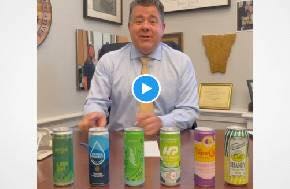
In another video, the congressman displayed six different beverage cans on his desk, asking, “How long would it take you to figure out what’s what amongst these six?”
“It took me a while to turn the cans around, having to read the fine print, and it’s tough,” he said. “And it shouldn’t be that tough, and especially shouldn’t be that tough for kids. We should be able to protect our kids from ingesting these intoxicating drinks and be aware of them, even as adults.”
The legislation charges the health and human services secretary and treasury secretary with carrying out its provisions, with their duties designated to the Food and Drug Administration (FDA) and the Alcohol and Tobacco Tax and Trade Bureau (TTB), respectively. Rules would need to be in place within two years of passage, and the requirements would apply to any covered drinks manufactured, distributed or sold after four years of the law being enacted.
Read full report